Solar momentum: turning rooftops into renewable powerhouses
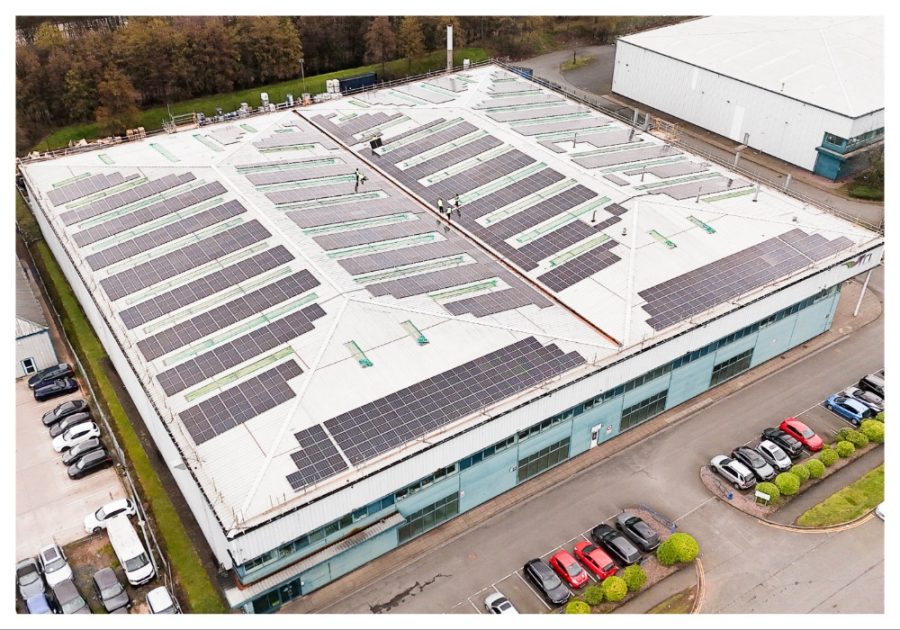
The solar array is expected to offset around 26% of TCL’s electricity use – a significant achievement for a site that consumes 1.4GWh of electricity annually
Solar power is moving from a niche sustainability measure to a mainstream operational strategy across the UK’s food and drink manufacturing sector.
What began as isolated pilot projects has evolved into a wave of large‑scale rooftop installations, driven by rising energy costs, Scope 2 reduction targets and the need for greater energy resilience. Across packaging, premium food supply and national retail logistics, companies are now treating their rooftops as assets capable of delivering long‑term commercial value.
A sector turning to solar
The shift is visible across multiple parts of the supply chain. Packaging producers are using solar to offset high‑intensity production loads. Cold‑chain operators are adopting PV to stabilise refrigeration costs. Retail distribution centres are deploying multi‑megawatt systems to support daytime operations. What unites these projects is that once solar proves its value, companies expand capacity, integrate digital monitoring and treat onsite generation as a core part of manufacturing.
TCL Packaging: solar as a production‑aligned investment
Flexible packaging manufacturer TCL Packaging has installed 1,176 solar panels at its Telford site, offsetting 26% of annual electricity use and cutting around 95 tonnes of CO₂ each year. With the factory consuming 1.4GWh annually, the installation provides a meaningful buffer against volatile energy markets.
Safety was a central design requirement. TCL specified SolarEdge DC‑optimised inverter technology, chosen for arc‑fault detection and SafeDC voltage‑reduction features — a configuration suited to the site’s multi‑orientation roof. A dedicated Firefighter Gateway integrates the system with the building’s alarm infrastructure, ensuring rapid shutdown capability.
This investment positions TCL to meet rising FMCG customer expectations for sustainable packaging while improving operational resilience.
Aubrey Allen: scaling solar through proven performance
Premium food supplier Aubrey Allen has expanded its rooftop solar for the third time, reflecting strong returns from earlier phases. The company’s refrigeration‑heavy operations make energy efficiency a priority, and its installations have already delivered a projected lifetime value of more than £166,700 while reducing reliance on grid electricity.
Phase Three brings the site’s total installed capacity to 431.1 kWp, generating an estimated 377,236 kWh of renewable electricity annually. The phased approach has allowed Aubrey Allen to build capacity over time, maximising roof space while investing further as each stage demonstrates measurable value.
As managing director Russell Allen notes in the company’s release: “Our commitment to sustainability is about more than reducing our own environmental impact… By investing in meaningful, long‑term improvements, we aim not only to reduce our carbon footprint but to inspire positive change across our sector.”
Iceland distribution centre: solar at logistics scale
At Iceland’s distribution centre in Livingston, Scotland, Seed Renewables and Zestec Renewable Energy have delivered a 1.5MW rooftop solar PV system funded by Octopus Energy Generation. The installation features 3,300 panels producing 1.6GWh of renewable electricity annually — enough to meet 95% of the site’s daytime power demand.
The project required detailed shutdown planning to protect millions of pounds of frozen and ambient stock, with installation carried out in a live logistics environment. Despite challenging weather conditions and operational constraints, the system was delivered within a 14‑week programme and is expected to save 202 tonnes of CO₂ annually.
The case study highlights a broader trend: distribution centres, with expansive roof space and consistent daytime loads, are becoming prime candidates for large‑scale solar deployment.
Why solar adoption is accelerating
Across these projects, several drivers are pushing solar into the mainstream:
- Energy cost volatility is making onsite generation financially attractive.
- Scope 2 reduction pressures are intensifying across the supply chain.
- Technological advances — including DC‑optimised inverters and arc‑fault detection — enable installations on complex industrial roofs.
- Operational resilience is now a board‑level priority, with solar providing predictable daytime power.
- Proven ROI encourages multi‑phase expansion, as seen with Aubrey Allen.
- Logistics and cold‑chain operations offer high‑yield opportunities due to stable daytime loads.
Food and drink producers are increasingly integrating energy generation with real‑time monitoring, predictive analytics and factory‑wide optimisation. Solar is becoming part of a broader digital‑first strategy where energy performance is tracked as closely as throughput, uptime and quality.
Topics
renewable electricity Scope 2 solar energy
PeopleOrganisationsAubrey Allen Iceland Seed Renewables TCL Packaging Zestec Renewable Energy