Fibre packaging moves up
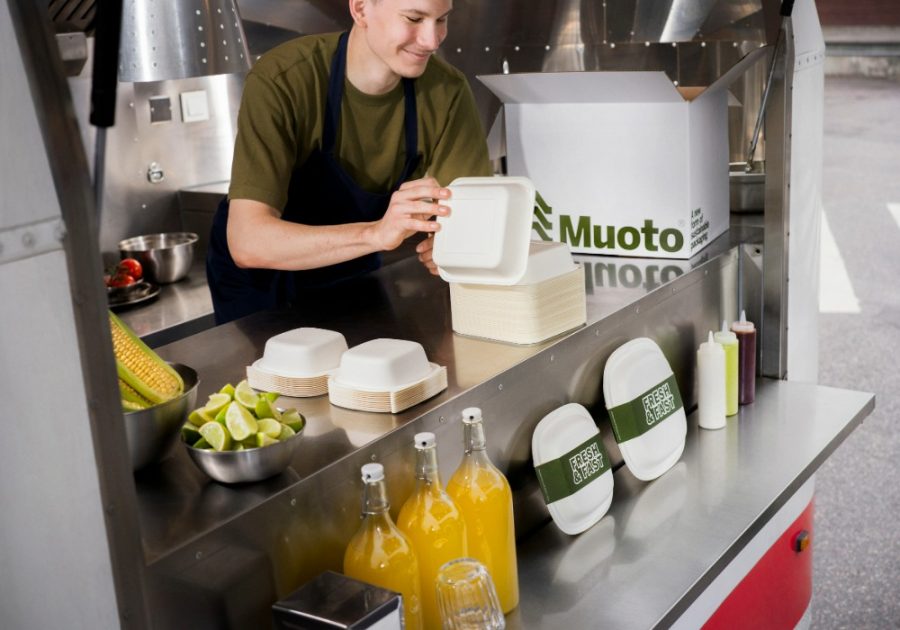
Metsä Group is moving its Muoto fibre packaging technology from demonstration towards commercial-scale production with a €25m investment in a new production line at its Äänekoski mill site in Finland.
The line, which is being supplied by technology company Valmet, is scheduled to start up in 2028 and will have a nominal capacity of more than 100 million products a year. It will be located alongside Metsä’s existing Muoto demonstration plant, providing the infrastructure and production environment for the technology to move into its next phase.
Muoto is designed to occupy a part of the packaging market where replacing plastic has traditionally been more difficult: applications that require a combination of stiffness, functionality, light weight and shaped form.
Metsä says the products can be used for demanding serving and food packaging and are produced directly from wet wood pulp, without intermediate processing steps.
That places the technology at an important point in the evolution of fibre packaging. The challenge for the sector is to create fibre packaging that can deliver the performance characteristics manufacturers and consumers expect from plastic, while fitting into increasingly demanding regulatory and environmental requirements.
Scaling is the real test
The move from a demonstration facility to a line capable of producing more than 100 million items annually is arguably the most important element of the announcement.
Fibre packaging has attracted considerable investment and innovation, but commercial adoption depends on more than proving that a material can be moulded into a particular shape. Food manufacturers need consistent production, competitive economics, reliable supply and packaging that performs through filling, transport, storage and consumption.
Metsä’s decision to locate the new line at its existing Äänekoski mill site is therefore significant. The company says the decision was based on the site’s infrastructure, the existing production line and investment costs.
It points towards a model in which the integration of fibre production and packaging manufacture becomes part of the proposition.
For manufacturers considering a move away from plastic, that could matter almost as much as the material itself.
Plastic replacement gets harder
The market opportunity is being created by a convergence of regulation and consumer pressure.
Metsä describes a strong market trend towards alternatives to plastic in certain product groups and argues that Muoto is positioned to benefit from the EU’s Packaging and Packaging Waste Regulation (PPWR).
The PPWR is changing the economics of packaging development by putting greater emphasis on waste prevention, recyclability and the use of packaging materials. For food manufacturers, that means packaging decisions increasingly have to be made against a combination of functionality, cost, recyclability, material efficiency and regulatory compliance.
Fibre is not automatically the answer to every application. But the more demanding the fibre solution becomes, the greater the potential market.
That is why technologies such as Muoto are important. They are attempting to move fibre beyond relatively straightforward paperboard applications and into shaped packaging where technical performance is critical.
A different fibre proposition
Muoto’s production process is also notable.
According to Metsä, the packaging is made directly from wet wood pulp, eliminating intermediate steps. The company says this allows the material to combine stiffness and functionality with low weight.
The key questions will be whether the technology can deliver the necessary mechanical properties at competitive material weights; whether packaging lines can handle the resulting formats efficiently; how the packs perform against moisture, grease and other food-contact challenges; and what happens to them at end of life.
The investment sends a market signal
The €25m commitment nevertheless sends a clear signal about where Metsä sees future demand.
The company is committing industrial capacity to a fibre packaging technology with a planned output of more than 100 million products a year.
That scale also gives food and drink companies an opportunity to evaluate fibre formats against real manufacturing requirements rather than laboratory or demonstration-scale performance.
The significance is heightened by another part of Metsä’s announcement. The company said it will not proceed with its planned Kuura textile fibre mill, citing significant global overcapacity in man-made cellulosic fibres and a lack of customers willing to pay a premium for responsibly produced materials.
The contrast is revealing.
Metsä is effectively reallocating investment towards a market where it sees stronger commercial potential, while stepping back from another bio-based materials opportunity where market economics have deteriorated.
That suggests the next phase of the bioeconomy will not be driven simply by the availability of renewable materials. Demand, price and performance will determine which technologies scale.
Competition
For food and drink producers, the development points towards a more competitive market for fibre packaging.
As regulation increases pressure on conventional plastic formats, manufacturers will need alternatives that work within existing production and distribution systems. The availability of larger-scale fibre solutions could give packaging developers more options, particularly for foodservice, serving and other applications where rigidity and three-dimensional form are important.
It could also accelerate a shift in how packaging development is approached.
Instead of asking simply whether plastic can be replaced with paper or board, manufacturers are increasingly likely to assess packaging at a systems level: what material delivers the required protection and functionality, at what weight, using what manufacturing process, and with what end-of-life pathway?
That is a much more demanding question — and one that will favour packaging technologies capable of delivering performance as well as a credible environmental proposition.
From niche alternative to packaging platform
The real test for Muoto will come in 2028, when commercial production begins.
If the technology can combine scale, cost competitiveness and food-packaging performance, the new line could help move moulded fibre further into applications that have historically been dominated by plastics.
The broader lesson for the food industry is that the transition away from fossil-based packaging is entering a different phase.
The market is moving beyond “Can we make this from fibre?” towards “Can fibre do the job at industrial scale?”
Metsä’s €25m investment suggests the answer is increasingly being tested on the production line.