Solar investment helps firms stabilise energy costs
Food and drink firms seek greater control over volatile energy costs
Food and drink manufacturers are accelerating investment in rooftop solar as they look to gain greater control over volatile energy prices and reduce reliance on the grid.
According to installer Fusion 360, enquiries from food and drink businesses have risen sharply since early 2026, driven by global instability and the sector’s heavy dependence on refrigeration and chilled storage.
Across UK industrial estates, factories, warehouses and distribution centres are increasingly covered in solar panels — a shift that reflects both cost pressure and the need for more resilient energy strategies. For a sector where refrigeration, chillers and refrigerated trailers consume significant power, solar is becoming a practical way to stabilise costs and strengthen supply‑chain security.
Joanne Skinner, commercial director at Fusion 360, said reduced reliance on mains electricity is now a major priority for producers.
“With energy‑hungry refrigeration and chillers, it’s clear why we’re seeing growing interest from businesses helping to feed Britain.”
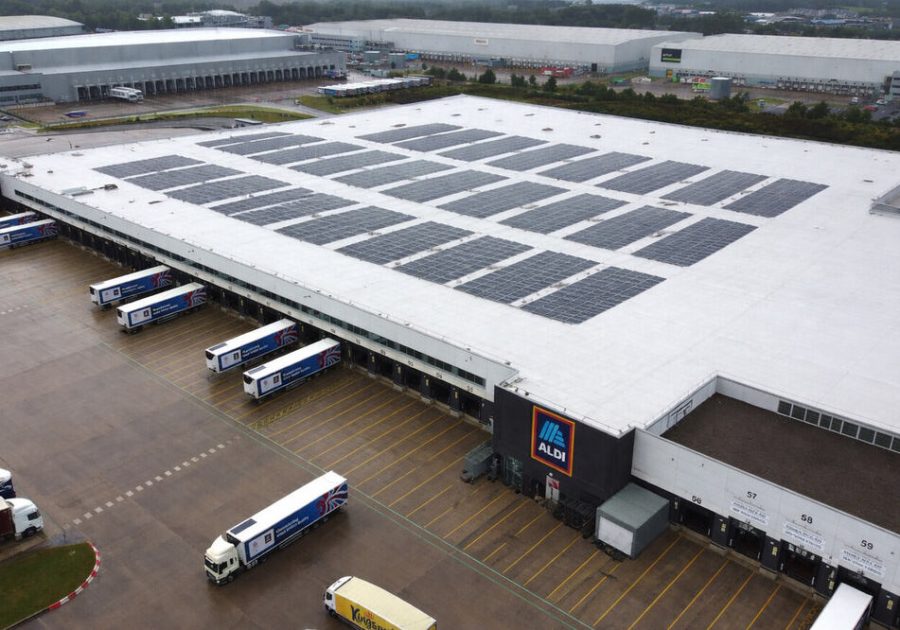
The company, which specialises in solar PV design and installation, recently replaced more than 4,000 panels at Aldi’s regional distribution centre in Bathgate, Scotland, upgrading the site to the latest generation of high‑efficiency technology. Continuous advances in PV performance, Skinner said, are delivering greater power output, longer life and faster returns on investment.
For many producers, the motivation is twofold: cutting emissions and insulating operations from unpredictable energy markets. The pandemic, conflicts in Europe and Asia, and the recent US‑Iran tensions have all heightened the need for more secure, self‑generated power.
Fusion 360 reports that food and drink companies are increasingly seeking systems that allow them to use solar power on site, with the option to restrict or export surplus energy depending on grid arrangements.
“Businesses tell us they want greater control and more predictable costs,” Skinner added. “With inflationary pressure across the food sector, onsite solar is one practical way to reduce exposure to volatile electricity prices.”
As energy uncertainty persists, rooftop solar is becoming a core part of how food and drink manufacturers manage risk, protect margins and future‑proof their operations.
Organisations