Re:imagining the line
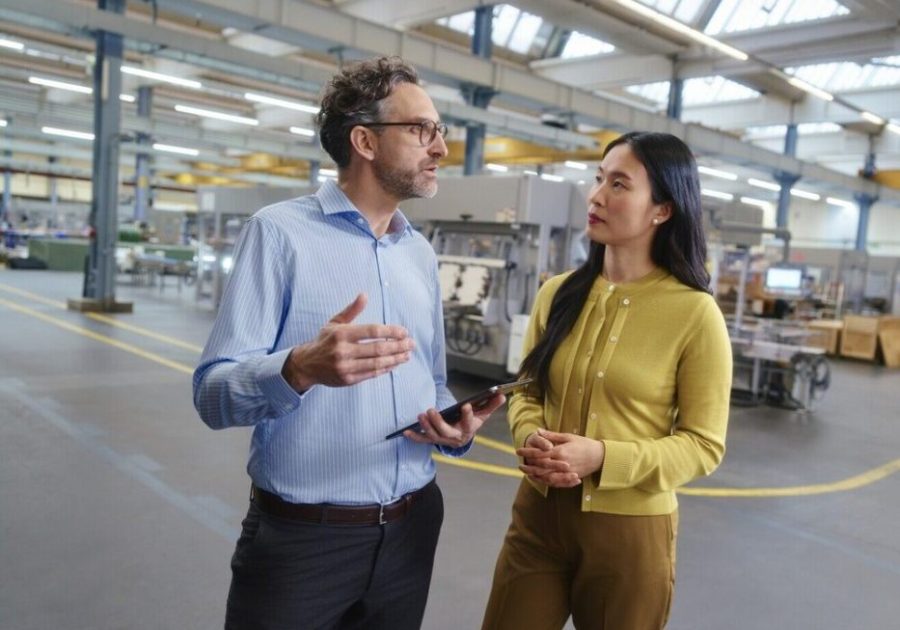
At PACK EXPO International, Syntegon will join its customers in “re:imagining” the Factory of the Future by providing answers to their most pressing challenges.
Manufacturers are no longer asking whether factories should become more automated and connected. The question is now how quickly they can evolve to cope with rising costs, labour shortages, increasing regulatory scrutiny and rapidly changing consumer demand.
That is the message underpinning Syntegon’s presence at Pack Expo International 2026, where the company is showcasing what it describes as the building blocks of the “Factory of the Future” across food, pharmaceutical and biotechnology production.
Rather than focusing on individual machines, Syntegon is positioning automation as part of a wider manufacturing strategy centred on flexibility, lifecycle support and AI-enabled production management.
Industry pressures driving factory transformation
Syntegon argues that manufacturers are facing a combination of structural challenges unlikely to ease in the coming years.
Escalating labour costs, difficulties recruiting skilled operators, shorter production runs, growing product portfolios and tighter regulatory requirements are forcing processors to rethink traditional production models.
The company’s longer-term vision is an operation capable of regulating itself, adapting automatically to changing production requirements and supporting operators through an AI-enabled control centre that uses real-time operational data to optimise performance.
For food manufacturers, this reflects a broader industry trend away from isolated automation projects towards connected production ecosystems where equipment, software and service support operate as an integrated system.
Flexible packaging designed for rapid changeovers
Among the highlights making their North American debut is neXt, Syntegon’s integrated packaging solution aimed at improving operational flexibility.
The system combines automated workflows, intuitive operator interfaces and real-time performance monitoring to reduce downtime while simplifying changeovers between different products and packaging formats.
The emphasis is less on replacing operators than allowing them to focus on higher-value production activities while automation handles repetitive tasks.
Alongside neXt, Syntegon is introducing the latest version of its SVX vertical packaging platform, capable of producing up to 300 bags per minute.
The platform has been designed to minimise cost per pack while supporting faster changeovers between bag formats and maximising productivity within increasingly constrained factory footprints. At Pack Expo, the company is demonstrating new capabilities for corner-seal bags alongside a complete frozen food packaging line.
Compliance remains central for pharmaceutical manufacturing
The Factory of the Future extends beyond food production.
For pharmaceutical and biotechnology manufacturers, Syntegon is highlighting technologies designed to simplify compliance with increasingly stringent sterile manufacturing requirements, including EU GMP Annex 1.
Its new SPC 4000 settle plate changer automates viable environmental monitoring, reducing manual intervention during production while increasing process security and equipment availability. The technology integrates with Syntegon’s vial filling lines to create more automated aseptic manufacturing environments.
Equipment becomes a long-term manufacturing partnership
Perhaps the strongest message emerging from Syntegon’s Pack Expo strategy is that machinery alone is no longer enough.
The company is increasingly positioning itself as a lifecycle partner rather than simply an equipment supplier, offering engineering support, commissioning, field service, AI-driven performance analytics and ongoing upgrades designed to maximise return on investment throughout an asset’s operational life.
According to CEO Torsten Türling, innovations are being developed alongside customers to solve real production challenges rather than technology for its own sake.
“Game-changing innovations, jointly developed with pioneering customers, deliver greater business impact in an environment defined by cost pressure, labour shortages, rising flexibility needs, and increasing regulatory complexity.”
Syntegon’s vision reflects a wider shift taking place across food and drink manufacturing. The factory of the future is increasingly being defined by connected, intelligent production environments where equipment, software, AI and service support function as a single ecosystem.
For manufacturers, success will depend on building production systems capable of adapting continuously to changing market demands, workforce pressures and regulatory expectations. Pack Expo 2026 suggests equipment suppliers are increasingly competing on that broader operational vision as much as on machine performance alone.