Steenvoorde wins friends in high places
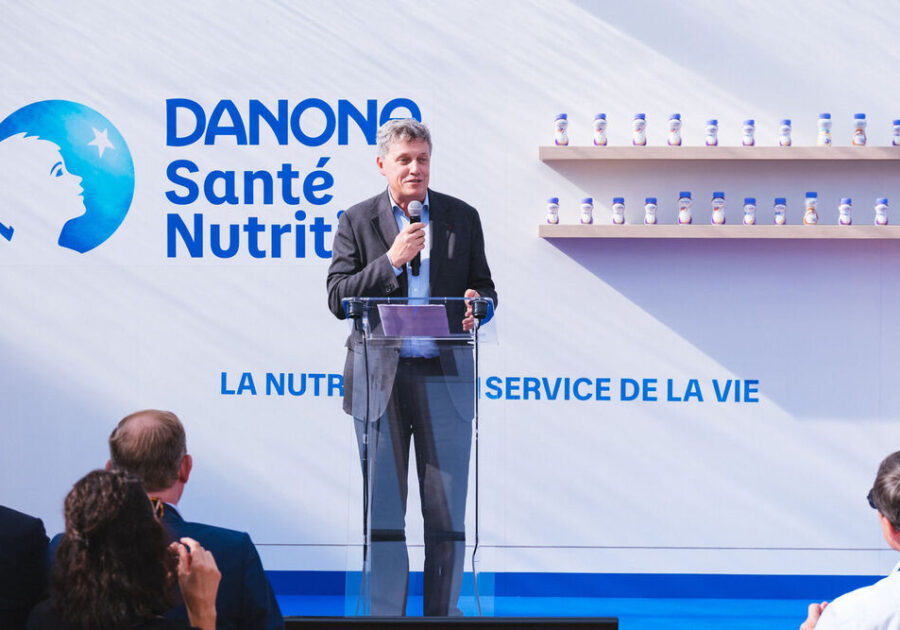
Ribbon-cuttings for a new production line don’t usually draw a Group CEO, a regional president and a state prefect to the same tent. Steenvoorde’s did — and each used the platform to make a different case for why the site matters.
A CEO’s centenary pledge
Danone Group CEO Antoine de Saint-Affrique opened by recalling a “cold, pouring rain” visit over two years ago, when the same commitment was first made. “Our commitment was to make Steenvoorde one of the pillars of our ambition in specialised nutrition,” he said, confirming it as the largest medical nutrition line Danone operates in France.
He tied the investment to demographics: the world’s over-60 population will double by 2050, he said, and “people are living longer, but not necessarily in better health.” Framing nutrition as clinical infrastructure rather than an add-on, he argued: “Nutrition is not an accessory or a complement to care. It is an essential component” — and, in a health system under strain, “not a cost, but an investment.”
De Saint-Affrique also confirmed the site’s next phase: a new, more advanced unit to separate milk into its component parts and convert them into nutritional ingredients — feeding Steenvoorde’s own line, but also destined for export across Europe. Milk collection from local partner farms, he said, has multiplied sixfold in four years.
“Proofs of love”
Hauts-de-France regional council president Xavier Bertrand explained the region’s decision to help fund the project in characteristically blunt terms: “Politics is like love — there are declarations, and there are proofs of love.” The region’s co-financing, alongside the state and the local communauté de communes, was that proof, he said, praising Danone for staying rooted in France despite its international footprint.
Bertrand framed medical nutrition around three life stages he said deserve public investment: “the dawn of life, the dusk of life, and life’s accidents” — birth, old age and illness. He also made an industrial-policy argument for manufacturing jobs specifically, saying factory work offers employees “a way to climb the ladder” that other sectors don’t.
A promise kept
Jean-Pierre Bataille, deputy for Nord’s 15th constituency and formerly Steenvoorde’s mayor, was present at the original 2024 announcement and returned to mark delivery. He credited Danone with keeping to its timeline — the roughly €60 million medical nutrition line, plus a separate €10 million biomass boiler, delivered in “an incredibly short timeframe” of under two years. He also raised the growing number of partner farms supplying the site, and voiced hope that the prices paid to them reflect their side of the bargain.
The state’s other kind of support
Closing the political remarks, the state’s regional representative — understood to be prefect Bertrand Gaume — positioned the state’s role as enabling rather than obstructive: “not red-tape administration,” but one there “to help projects get built.” He confirmed fresh state-backed support of around €60 million for Steenvoorde’s forthcoming milk valorisation unit, due to begin next year, and said the prefecture has written to central government to back the site’s funding candidacy through to 2030.
The numbers behind the speeches
Site director Emmanuel Varigas set the scene with the headline figures: €70 million invested in total, nearly two years of work to prepare and install the line, more than 400 direct jobs on site and over 1,000 estimated indirect jobs, built on relationships with 400 partner farms supplying local, French raw material.
Between them, the speeches framed Steenvoorde as more than a factory upgrade — a test case, in the words on stage, for how private investment, regional politics and public health policy can be made to point in the same direction.
TopicsPeople
Antoine de Saint-Affrique Bertrand Gaume Jean-Pierre Bataille Xavier Bertrand
Organisations