Spinning straw into packaging gold
Irish researchers at Teagasc Ashtown are looking at cereal straw, long treated as a farm by-product, as the raw material for compostable fresh produce packaging, with early tests suggesting it can hold its own against compostable films already on the market.
Waste with hidden depth
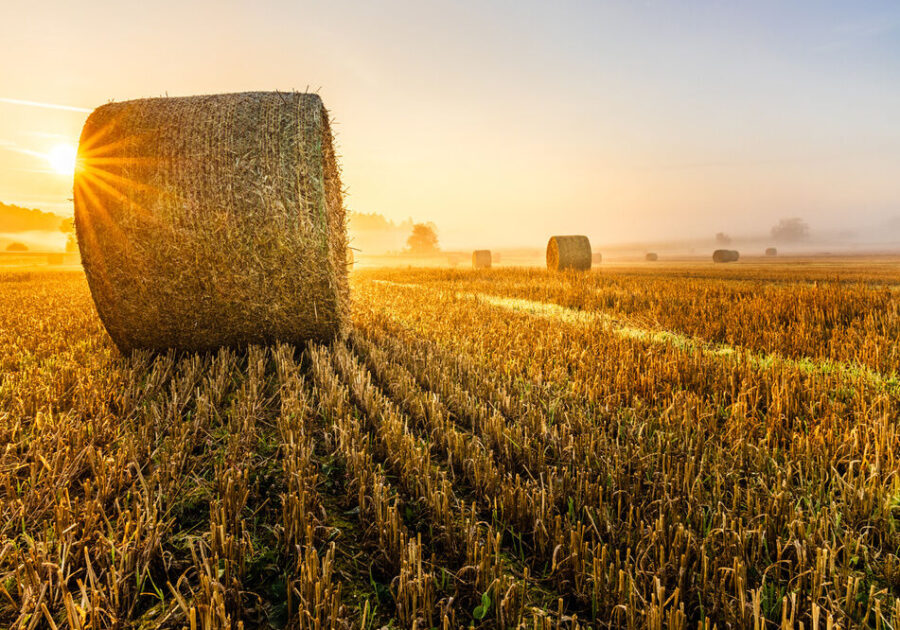
Wheat and oats are among Ireland’s major cereal crops, and harvesting them leaves behind large quantities of straw. According to Teagasc, this local, renewable and low-cost feedstock has traditionally been used mainly for bedding or mulching, or simply left to decompose.
The SUSTAINPACK+ project, based at Teagasc Ashtown’s Food Research Centre and funded by the Department of Agriculture, Food and the Marine, is seeking to raise the profile of straw and show what else it can do.
Chemically, straw contains two natural biopolymers: cellulose and lignin. Cellulose, the same building block found in trees and cotton, gives plants their strength, while lignin provides rigidity and natural protection against UV light and microbes. Shivani Pathania, senior research officer at Teagasc Ashtown, has been examining how the two can best serve packaging applications. Extracted and engineered correctly, she explains, they can be turned into films designed to protect fresh produce.
“Instead of relying on imported bioplastics, Ireland could use its own agricultural by-products to create packaging solutions that are both sustainable and economically viable,” says Pathania.
A packaging problem that won’t go away
The research is aimed squarely at fresh produce, where single-use plastic is deeply embedded, from berries to leafy greens. Citing 2025 Eurostat data, Teagasc notes that the EU generated 79.7Mt of packaging waste in 2023, equivalent to 177.8kg per person. That is a small reduction on 2022 but still 21kg higher than a decade earlier.
Plastic remains a major contributor. On average, each EU resident generated 35.3kg of plastic packaging waste, of which only 14.8kg was recycled. Paper and cardboard made up the largest share of all packaging waste at 40%, followed by plastics at 19.8% and glass at 18.8%.
Fresh produce, Pathania points out, is a particularly demanding application: it needs flexible materials with controlled moisture, oxygen management and physical strength to prevent bruising. “Compostable alternatives exist, but many struggle with moisture sensitivity or poor mechanical properties,” she says. “This is where straw-based packaging may offer a breakthrough.”
From stalk to film
In the lab, the team separates the cellulose and lignin using what Pathania describes as cleaner, low-impact methods, rather than strong chemicals and large amounts of water.
The cellulose is then converted into nanocellulose, a very fine and very strong material. When added to biodegradable plastics such as PLA or PCL, it makes packaging film stronger and improves oxygen and moisture barriers, helping produce stay fresh for longer.
Lignin brings its own benefits. It naturally blocks UV light, slows spoilage and helps protect fruits such as strawberries, raspberries and cherries from damage. Combined, the two components create compostable packaging that Teagasc describes as strong, protective and suitable for fresh food.
Early tests show straw-based materials can perform better than many compostable films already on the market, keeping oxygen and moisture at the right levels during storage and transport. The films could be used for everything from leafy greens to tomatoes.
Still some way from the shelf
Teagasc is clear that supermarket shelves are not imminent. The project still needs to fine-tune the production process and test the materials’ machine runnability, strength and biodegradability. The materials must also be worked through with industry partners and meet regulatory requirements. Even so, the organisation says that if progress continues at its current rate, pilot-scale production of straw-based packaging might not be far off.
One to watch
For packaging and produce businesses, the interest here lies less in a single material than in the combination of claims. Compostable options already exist, but Pathania’s point is that many are held back by moisture sensitivity or weak mechanical properties. Early evidence that a straw-derived film can match or beat existing compostable films on oxygen and moisture control speaks directly to that gap.
There is a supply-chain argument too. Pathania frames straw as a way to cut reliance on imported materials, build a local, circular system, give farmers a new source of income and help Ireland grow its bioeconomy. Turning even a small portion of a plentiful by-product into packaging, she says, could do all of that while reducing plastic waste.
The caveats matter. Machine runnability, biodegradability and regulatory approval are the tests that decide whether a promising laboratory result becomes a commercial product, and they remain ahead of the project. For now, straw is a material to watch rather than one to specify.