UK food chains warned over multiple shocks
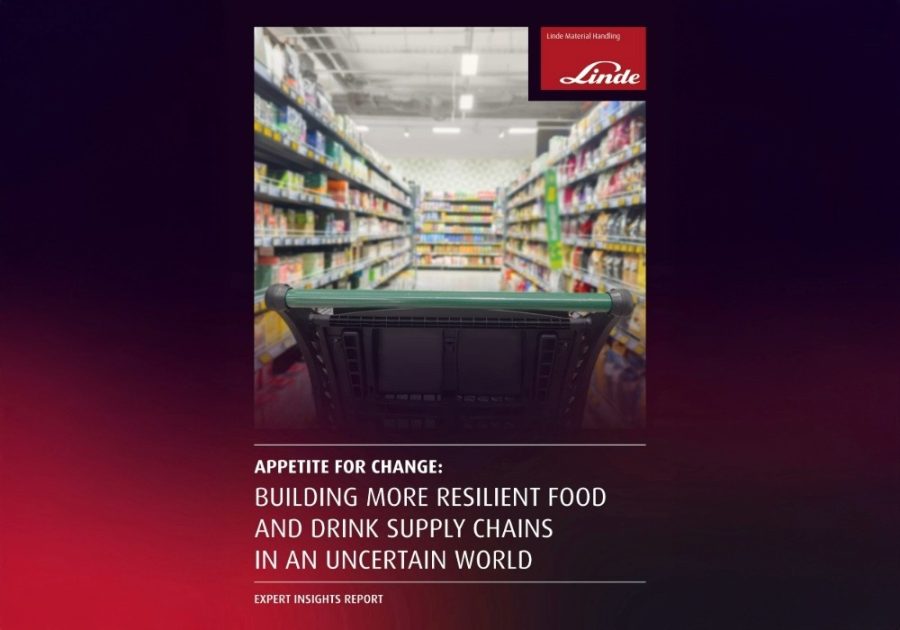
UK food and drink businesses must prepare for several major disruptions occurring simultaneously, rather than planning for individual risks in isolation, according to a new expert insight report from Linde Material Handling UK.
The report, Appetite for Change: Building More Resilient Food and Drink Supply Chains in an Uncertain World, draws on perspectives from food, logistics, sustainability and supply chain experts, including representatives from The Cold Chain Federation, Planet Farms, Lincoln Institute for Agri-Food Technology, Sheffield Hallam University’s Advanced Food Innovation Centre, Cranfield School of Management, EcoVadis, the UK Warehousing Association, CHEP UK & Ireland, Flow Skills Online, the Provision Trade Federation and Palletways UK.
It warns that climate disruption, energy volatility, geopolitical instability, water scarcity, cyber-attacks and animal disease outbreaks could combine to place severe pressure on food production and distribution.
Converging pressures, not isolated risks
Around 40% of the UK’s food is imported, leaving businesses exposed to disruption across international sourcing and trade routes. Roughly half of the country’s food supply depends on the cold chain, while approximately half of UK cold stores are more than 20 years old — a combination the report flags as a particular point of vulnerability.
Climate disruption, water scarcity and changing growing conditions are also set to reshape food production, storage and distribution more broadly.
An ageing workforce under strain
The report highlights the continuing fragility of the logistics workforce. The average UK driver is now aged over 55, with too few new recruits entering the sector. As food and drink products must continue to be collected, transported and delivered regardless of disruption, developing a sustainable workforce is identified as a critical resilience priority.
Drivers, the report notes, can also provide valuable real-time intelligence about emerging disruption, complementing historical data and digital forecasting.
Beyond just-in-time
Businesses are moving beyond highly lean, just-in-time models towards more balanced just-in-case strategies, supplier diversification and additional warehousing capacity. The report recommends diversifying sources of supply and considering additional warehousing, regional distribution capacity and reserve stock where products allow.
Adaptable logistics models, including pallet networks and consignment stock, are highlighted as ways businesses can secure smaller or urgent deliveries when established arrangements come under pressure. Electrification is also expected to support lower-carbon distribution, though charging capacity, vehicle efficiency and the demands of continuous operations remain barriers.
Digitalisation’s double edge
AI, automation, sensors and predictive analytics can improve forecasting, traceability and decision-making, but greater digitalisation is also increasing cyber risk. The report recommends that cyber-resilience plans explain how teams will communicate and operate if digital systems fail, and that these plans be tested through regular simulations.
Sustainability as a resilience issue
The report frames sustainability as increasingly integral to operational resilience, noting that Scope 3 emissions in the food and beverage sector average 45 times those from direct operations and purchased energy. Stronger collaboration between producers, manufacturers, logistics providers, retailers and policymakers is described as essential, since no single organisation can secure the supply chain independently.
No room for complacency
Ben Griffiths, sales director (business development) for Linde Material Handling, said: “The food industry’s success in overcoming previous disruption should not create a false sense of security. The next crisis may involve several pressures arriving at once, affecting production, storage, transport and workforce availability.
“Resilience must therefore be designed into the entire supply chain. That means stronger contingency planning, more adaptable logistics, greater visibility, robust cyber protection and investment in the people, infrastructure and technology needed to keep essential products moving.”
What It Means
The report’s central argument is one of sequencing risk rather than simply cataloguing it and the prospect of several landing together — on production, storage, transport and labour simultaneously — that businesses are being urged to plan for. With nearly half of UK cold storage infrastructure ageing and the driver workforce ageing alongside it, the resilience case being made here is as much about long-term infrastructure and people investment as it is about contingency planning for the next acute shock.
TopicsPeopleOrganisations
CHEP UK & Ireland Cranfield School of Management EcoVadis Flow Skills Online Lincoln Institute for Agri-Food Technology Linde Material Handling UK Planet Farms Provision Trade Federation and Palletways UK Sheffield Hallam University's Advanced Food Innovation Centre The Cold Chain Federation UK Warehousing Association