Sonoco’s latest innovations shield manufacturers from EPR fees
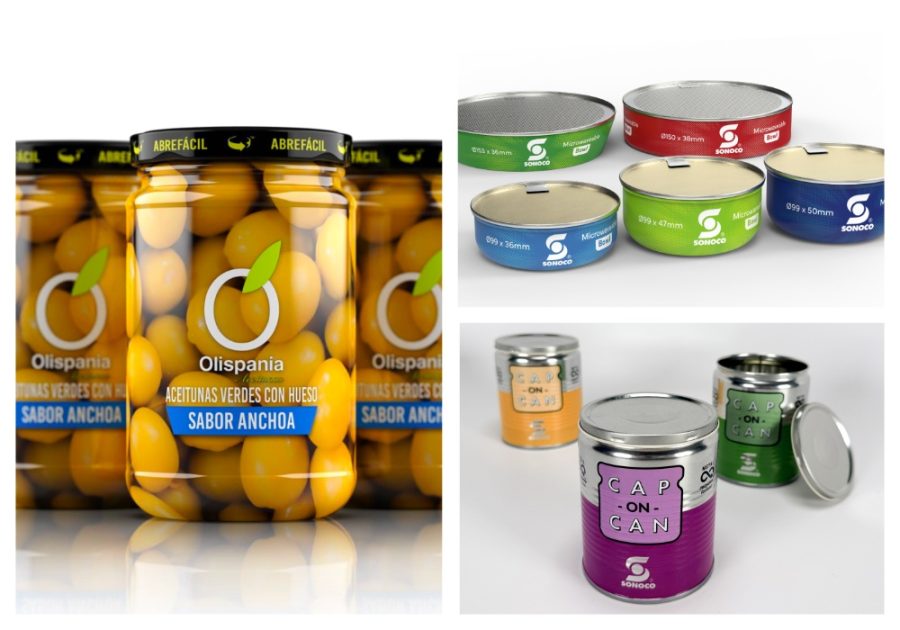
From left: Orbit; (top right) Certified microwaveable metal bowls; CapOnCan
The global food and drink manufacturing sector is facing an unprecedented design challenge.
With the European Union’s Packaging and Packaging Waste Regulation (PPWR) raising compliance bars and a critical August regulatory milestone looming, brands are under immense pressure to strip plastics from their portfolios and embrace materials recycled at scale.
At Interpack, packaging giant Sonoco answered this pressure with a wave of next-generation circular innovations. By introducing highly engineered alternatives to plastic trays, glass jars, and multi-material containers, Sonoco’s latest portfolio signals a definitive shift toward pragmatic, single-stream recyclability.
For food and beverage manufacturers, these releases provide a blueprint for how to future-proof packaging portfolios while protecting margins and enhancing consumer utility.
CapOnCan: disrupting glass and eliminating the vacuum hole
Leading Sonoco’s announcements was the public debut of CapOnCan, a breakthrough innovation positioned to disrupt the market for family-sized food and pet food packaging.
Historically, when manufacturers required a rigid, resealable, and airtight container for ambient shelf-life products, they defaulted to a heavy glass jar paired with a metal closure. According to Sonoco, CapOnCan is the industry’s first real hermetic, resealable food can that completely removes the need for a vacuum hole or an external label.
Sonoco stresses that the development means:
- Drastic weight and logistics reductions: by swapping glass for an entirely metallic structure, manufacturers can drastically shave down the tare weight of their finished goods. This yields direct freight cost savings and lowers secondary supply chain carbon emissions.
- Slashing EPR fees via mono-materiality: because CapOnCan utilizes a metal body integrated with a hermetically sealed metal cap, it functions as a single-material steel asset. In markets governed by strict Extended Producer Responsibility (EPR) schemes, mono-material metal structures qualify for significantly lower fee thresholds compared to multi-material components or complex plastics.
- Post-opening consumer convenience: for pet food or multi-serve human food applications, the ability to cleanly break a hermetic seal and then tightly reseal the container for fridge storage solves an enduring consumer pain point — maintaining freshness post-activation without requiring separate storage containers.
The microwaveable metal bowl
For years, the convenience food and ready-meal sector has been structurally reliant on plastic trays, many of which — especially black plastics — face severe sorting and recycling challenges at materials recovery facilities (MRFs). Sonoco’s new AFNOR-certified microwaveable metal bowls represent a direct assault on this paradigm.
By achieving official certification from the Association Française de Normalisation (AFNOR) for microwave safety, Sonoco has neutralised the primary barrier that prevented metal from entering the ready-meal space.
Manufacturers can bypass recycled-content mandates by switching to a metal bowl format that is already recycled at scale globally, evading plastic supply volatility and regulatory penalties. The bowls also give brands an immediate, verifiable drop in scope 3 upstream emissions.
The paperisation of dry goods: GreenCan gains momentum
Beyond advancements in metal, Sonoco utilised Interpack to showcase the acceleration of its paper-based portfolio, headlined by GreenCan. Designed specifically for dry food applications like coffee, salt, and icing sugar, GreenCan features up to 98% paper content constructed from 100% recycled paperboard.
At the showcase, major brands demonstrated how they are commercializing this format. Cristal Union’s iconic Daddy sugar brand shared the stage to detail how it leveraged Sonoco’s paper-based alternative to reduce plastic consumption by 80% for its powdered sugar range. Similarly, the Noirmoutier Sea Salt Cooperative adopted GreenCan to protect its artisan salt against humidity without resorting to an internal aluminium or plastic liner.
To round out this paper push, Sonoco also displayed a multi-purpose paper membrane designed to replace traditional plastic sprinkler lids, enabling a completely integrated paper-to-paper packaging profile.
Brands are now presented with a few options such as kerbside recyclability for dry goods. The high paper composition allows consumers to safely discard the entire empty container into standard residential paper recycling bins, removing the friction of multi-component separation. There is also high barrier performance. Through tailored interior barrier coatings, GreenCan provides the oxygen and moisture defence lines needed for sensitive powders and hygroscopic goods like salt and sugar.
Engineering accessibility: the Orbit close-up
Completing the line-up was Sonoco’s Orbit metal end technology, which is gaining rapid traction as major retail groups actively pressure brands and fillers to adopt it. Engineered to address a widespread consumer accessibility complaint, the Orbit design reduces the torque and physical force required to open a traditional glass jar closure by 50%. Featured at the show on Olispania’s olive jars, the technology bridges the gap between premium product protection and inclusive design.