UK’s fruit and veg supply chain exposed to climate risk
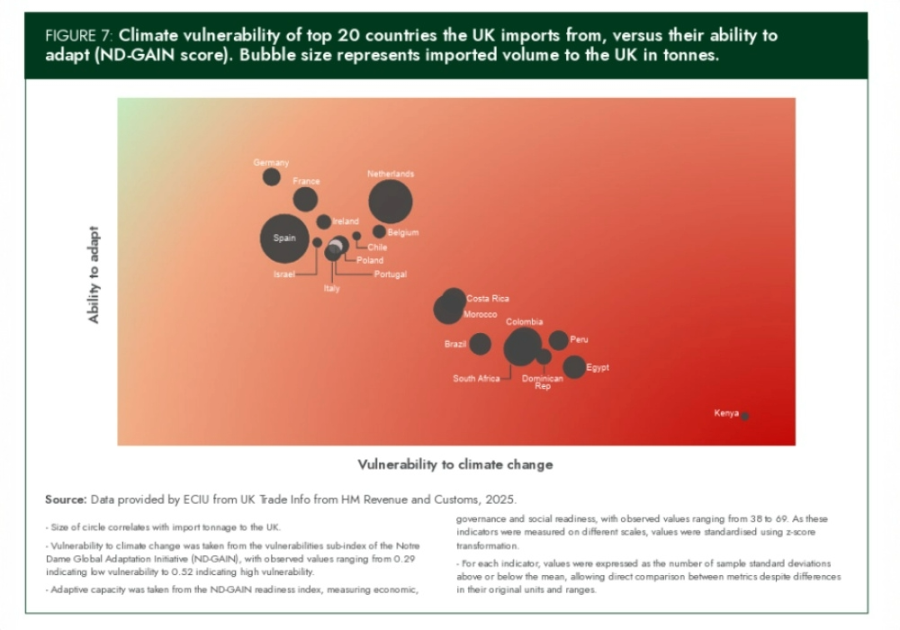
A new report from The Food Foundation, Farming for 5-a-day: how resilient is the UK’s supply of fruit, veg and beans in a changing climate?, lays out an uncomfortable truth: even as the UK contends with its own wildfires and drought, it remains considerably less exposed to climate change than most of the countries it relies on to fill supermarket shelves.
Key findings include:
- Of the top 20 countries the UK imports fruit and vegetables from, 18 (90%) are moderately to severely vulnerable to climate change.
Of the UK’s nine most-purchased fruits, five could be grown domestically (apples, strawberries, blueberries, raspberries, pears) — yet self-sufficiency sits under 40% for four of them. Some fruits, including citrus and bananas, are entirely import-dependent. - Among top vegetables — tomatoes, mushrooms, peppers, cucumbers, onions, broccoli and green beans — only carrots achieve high self-sufficiency (94%). Every other major vegetable sits below 50%.
- There is a stark mismatch between what government dietary guidance recommends and what UK farms actually grow: fruit and veg should make up 41% of our diet, yet they account for just 7% of domestic food production.
- The UK imports 40% of all its food, but a striking 80% of its fruit and 47% of its vegetables — giving it one of the highest fruit import-dependence rates in Europe.
The report lands against a backdrop of well-documented public health shortfalls, with fewer than one in three UK adults, and under one in ten teenagers, eating their five-a-day.
Why this matters now
The IPCC’s own projections point to declining yields, heat stress and quality degradation across global fruit and vegetable production if adaptation doesn’t accelerate — with the Mediterranean, North Africa, and South and Central America (regions the UK leans on heavily) flagged as particularly vulnerable. In other words, the very supply base the UK depends on to plug its production gap is the part of the system most likely to falter first.
Anna Taylor, executive director of The Food Foundation, put it plainly: the risk is that climate-driven disruption abroad “drives up prices in the future, putting nutritious foods further out of reach for many.” Ali Capper of British Apples and Pears Ltd went further, framing this as a live test of the government’s “food security is national security” rhetoric, and calling for certainty on seasonal labour, water access, planning rules and energy costs to let growers actually scale up.
Perhaps the sharpest comparator came from Professor Paul Behrens (Oxford Martin School), who noted the Netherlands — with nearly double the UK’s population density — has around 1,770 hectares under glass for tomatoes alone, dwarfing the UK’s entire protected vegetable area of 866 hectares. Four decades of consistent, innovation-led Dutch policy versus the UK’s comparative underinvestment is, in his words, the choice Britain never made.
The Food Foundation wants government to use the forthcoming Horticulture Sector Growth Plan to set statutory targets for both fruit and veg consumption and domestic production share, backed by investment in climate adaptation and supply chain resilience. The prize on offer is significant: sector growth advocates point to over 20,000 potential new jobs and a 3% uplift to farm profits nationally.
Implications
For manufacturers, this report is an early warning on supply chain risk, and it carries several practical implications:
1. Input volatility is a structural risk, not a one-off shock. With 80% of fruit and nearly half of vegetables imported — much of it from climate-vulnerable regions — manufacturers reliant on fruit and veg as ingredients (juices, purees, ready meals, bakery fillings, snacks, baby food) should expect recurring price and availability shocks rather than isolated bad-harvest years. Longer-term forward contracts, diversified sourcing geographies, and closer collaboration with UK growers on multi-year agreements will matter more than opportunistic spot buying.
2. Domestic sourcing becomes a commercial and reputational lever. As consumer and retailer attention to food security sharpens, “British grown” provenance could shift from a marketing nicety to a genuine differentiator — particularly for private label ranges and premium tiers. Manufacturers able to lock in UK-grown supply for tomatoes, berries, brassicas or salad crops may find both cost stability and shelf appeal.
3. Reformulation and NPD pressure around the 5-a-day gap. With statutory consumption targets potentially on the horizon, manufacturers of processed and convenience foods may face growing policy and retailer pressure to increase fruit/veg content, echoing the trajectory seen with sugar and salt reduction. Early movers on veg-forward reformulation, fortification, or added-veg product lines could get ahead of any incentive or reporting regime that follows the Growth Plan.
4. Investment opportunity in the supply chain itself. The Dutch glasshouse comparison is instructive: sustained capital investment in protected cropping, controlled-environment agriculture and post-harvest infrastructure could open opportunities for manufacturers to co-invest with growers or offtake partners, securing supply while supporting UK capacity-building — a hedge against both climate and geopolitical disruption abroad.
5. Watch the Horticulture Sector Growth Plan closely. Any statutory targets, funding mechanisms (eg seasonal labour, water infrastructure, energy costs for growers) or procurement incentives that emerge will shape input costs and sourcing strategy for years. Manufacturers with a stake in fruit and veg categories should be engaging with the consultation process now, not reacting after publication.
The bottom line
The Food Foundation’s report reframes fruit and veg imports as a climate exposure problem hiding in plain sight. Manufacturers will have to diversify carefully, engage with domestic growers early, and treat any coming policy shift on production targets as a signal to act now rather than adapt later.