Fresh Inset Vidre+ extends table grape marketable life
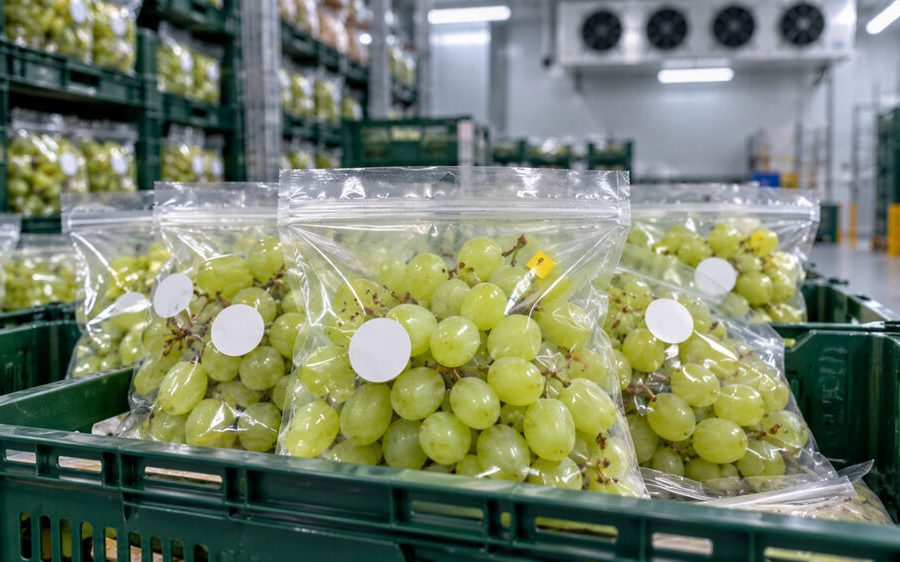
Table grapes undergo extended cold storage and long-distance transport before reaching distribution hubs and retail display. Throughout this supply chain, produce quality is vulnerable to degradation, primarily evidenced by stem (rachis) browning, fungal decay, and physical damage such as berry shatter.
To determine the efficacy of Vidre+ technology in mitigating these post-harvest losses, Fresh Inset conducted a series of trials between 2022 and 2024 across key European production and retail markets, including Italy, Greece, Spain, and the United Kingdom.
The trial programme encompassed 38 treatment variants and 354 paired comparisons against untreated controls. Assessments evaluated leading commercial varieties — such as Italia, Soultanina, Aledo, Dominga, and Sweet Celebration — under diverse storage conditions and packaging formats, ranging from loose bulk boxes to flow-wrapped retail punnets.
Five additional days of commercial acceptability
Data derived from time-to-equal-quality shift modelling across all trial data showed that Vidre+ treatment extended the marketable life of table grapes by an average of 4.95 days — a overall increase in marketable lifespan of approximately 35%.
Performance gains were measured across several critical quality metrics:
- Berry shatter and integrity: Vidre+ delayed the onset of berry shatter and mechanical damage by 10.5 days on average, representing a 65% improvement compared to untreated controls.
- Rachis preservation: stem browning, a key visual indicator of age and freshness for retail buyers, was delayed by 5.6 days (+35%).
- Decay control: incidences of post-harvest fungal decay, specifically Botrytis cinerea and Mucor spp., were delayed by an average of 4.8 days (+28%).
In consumer-focused retail assessments conducted in the UK on Sweet Celebration punnets, the technology extended the period of visual consumer purchasing appeal by up to two days.
Methodology and statistical stability
The trial methodology evaluated total commercial viability rather than selectively reporting optimal conditions. Both positive and negative variant outcomes were retained within the mathematical model.
Across multiple averaging methodologies — including equal weighting per trial, variant median calculations, and total pooled comparisons — the resulting extension remained consistently within the range of 4.6 to 5.7 days. This confirms the operational reliability of Vidre+ across different microclimates, packaging configurations, and grape cultivars.