Home Harvest: the indoor farming technology aiming to change the way the world eats
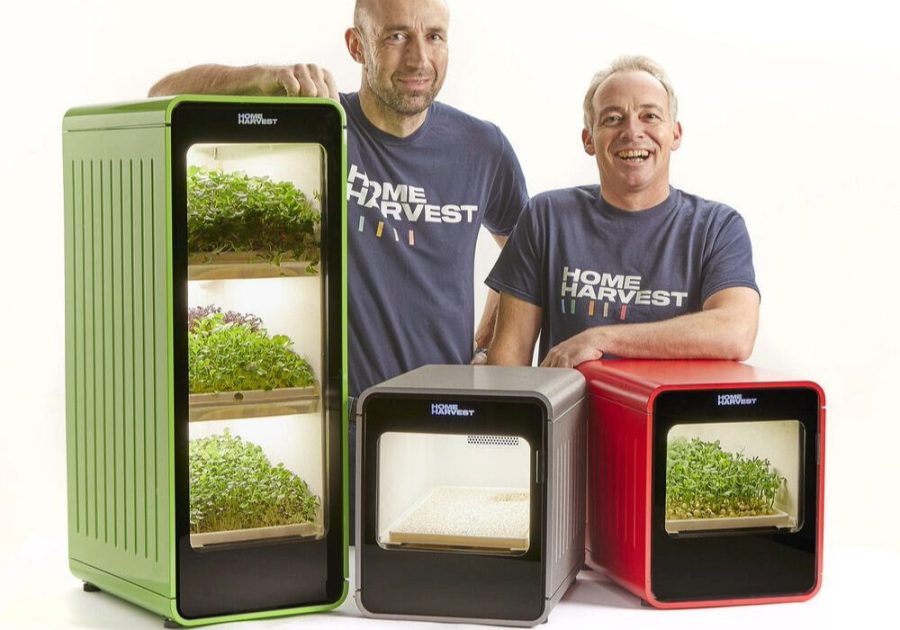
Home Harvest co-founders Andrew Johnson and Hedley Aylott.
By the time most supermarket salad reaches the plate, it has already travelled hundreds – sometimes thousands – of miles, spent days in transit and refrigeration, and generated significant waste before it is even consumed. Home Harvest believes there is another way.
A British smart farm technology company is positioning itself at the intersection of food technology, wellness, sustainability and connected living with an ambitious proposition: enabling households to grow microgreens, herbs and salads inside their own homes within days of planting.
At an immersive preview event in London showcasing what the company describes as the “world’s smartest indoor farm”, the vision was presented not as a niche gadget for hobby growers, but as a mainstream consumer appliance designed to fundamentally rethink freshness, nutrition and food supply.
The technology combines controlled environment agriculture, app connectivity, AI-supported growing and pre-seeded growing mats to create an automated indoor farming experience requiring minimal intervention from users. Consumers simply insert a seed mat, add water and allow the system to manage the growing environment.
For co-founder Andrew Johnson, whose background includes inventing the “living salad” category sold into supermarkets across Europe, the project emerged from a bigger question around sustainability and food access.
“Having worked in the salad industry for many years I know first-hand the amount of waste produced by the sector as well as the environmental impact,” Johnson explains.
“Around 30% of leafy salad crops planted are consumed, with the rest of the crop wasted.
“The UK imports about 1,000 trucks of leafy salads weekly from Southern Europe and Africa, with approximately 400 trucks’ worth being thrown away.”
Against that backdrop, Home Harvest is attempting to shrink the distance between production and consumption to almost zero.
Closing the ‘freshness gap’
At the core of the Home Harvest proposition is what the founders describe as closing the “freshness gap” between harvested produce and consumption.
Johnson says the smart farms are designed to replace “depleted supermarket produce” with “hyper-fresh, pesticide free salads, brassicas and herbs”.
The company’s systems rely on controlled environment agriculture technology. Temperature, humidity and lighting are all regulated inside the unit, while cameras monitor crop development and app connectivity enables users to oversee the process remotely.
“Users can monitor plants, temperature, humidity and refine the environment to optimise performance,” the company explains.
The result is a growing system capable of producing crops in as little as eight to 10 days.
Inside the units, shelves are illuminated using tailored light cycles that optimise the growing conditions for individual crops. Different seed mats are paired with specific growing programmes, enabling the system to automatically adapt the lighting schedule and environmental controls.
“The whole point was to create a unit under £400 that allows people without any experience to reliably grow large quantities of what they buy and what they should be eating,” explains Hedley Aylott during the demonstration.
The emphasis on simplicity is central to the company’s strategy.
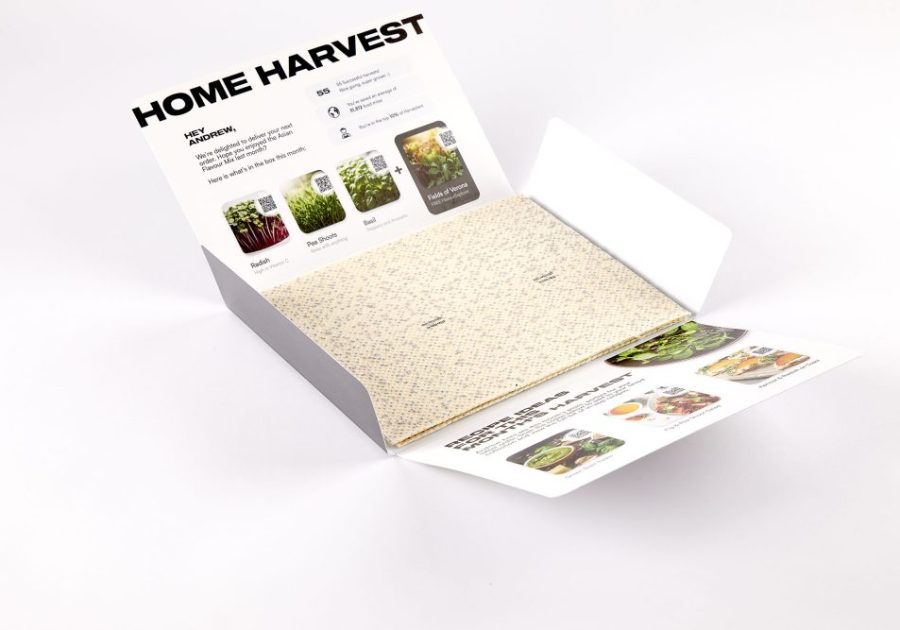
Seed mat.
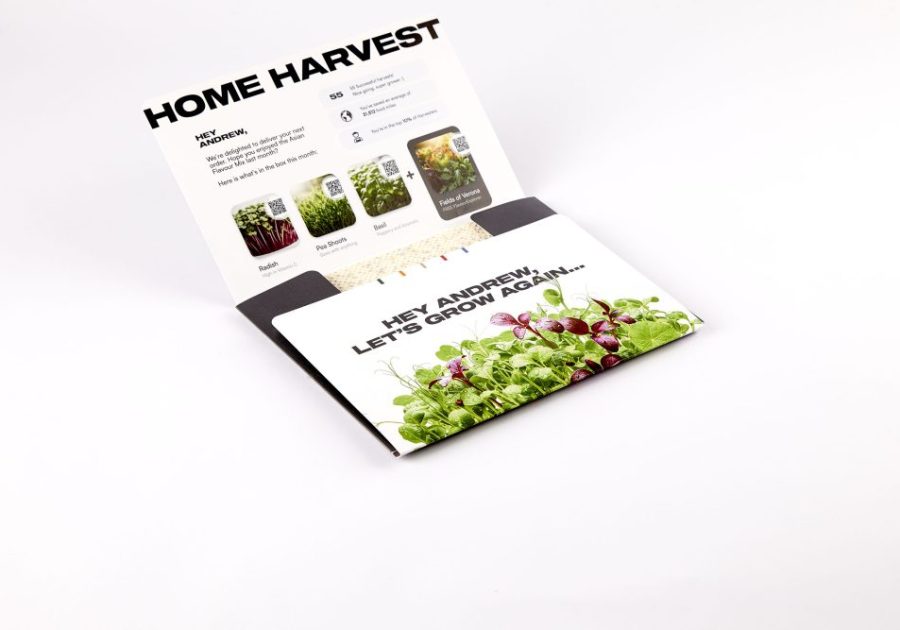
Home Harvest’s seed mats arrive pre-prepared with seeds fixed into place at specific densities. Users scan a QR code through the accompanying app, insert the mat and allow the system to handle the agronomy automatically.
“This is connected growing where all agronomy is automated,” the company says.
The smart farms also include water level indicators, removable tanks for cleaning and app-based crop monitoring. Time-lapse imagery and live crop photography can be viewed remotely, adding an experiential element to the process alongside the functional benefits.
The wider objective is to make indoor farming accessible to consumers who may have no gardening experience at all.
“Everyone likes a nice garden, but no one wants to do the hard work,” Aylott notes.
From salads to ‘functional nutrition’
While indoor growing systems have existed for years, Home Harvest is attempting to differentiate itself by focusing not only on convenience but on nutrition and recipe-led growing.
The company positions its seed mats as part of a broader wellness ecosystem.
“The team’s seed mats are designed to relate to recipes and health, enabling people to grow with specific outcomes in mind, such as prenatal health, gut health, or because they love Italian food and want to grow their own herbs for cooking,” the company says.
Different blends showcased at the event included mixes inspired by world cuisines as well as health-focused varieties formulated around specific nutritional requirements.
Johnson describes the produce as “functional, clean, affordable nutrition”, while Aylott framed the wider ambition in even broader terms.
“Wellness around the world is challenged by poor diet and lack of access to the right food,” he says. “Our smart farms are empowering people to take control of their health by growing their own produce at home.
“The market for hyper-fresh, pesticide-free produce is no longer a niche luxury – it is a global health necessity and we are transforming the home into a personal pharmacy replacing expensive and artificial supplements.”
Taste is also a major part of the proposition.
During the demonstration, microgreens including radish shoots, pea shoots and oriental mixes delivered notably intense flavours, reflecting the company’s emphasis on freshness and controlled cultivation.
Johnson argues that freshness fundamentally alters both flavour and nutritional quality.
“There’s no packaging, there’s no waste. You only cut what you need,” he says.
The focus on living produce also taps into changing consumer attitudes around food provenance, freshness and wellbeing.
Rather than purchasing pre-packaged salads with limited shelf life, Home Harvest is effectively encouraging consumers to harvest only what they intend to eat, when they intend to eat it.
The system’s subscription model is designed to support that approach. Consumers will receive seed mats regularly, enabling continuous production at home.
According to the company, the subscription package is intended to supply three to four seed mats every month and is positioned as being cheaper than purchasing equivalent salads from supermarkets while significantly reducing food waste.
AI, data and the connected kitchen
Beyond indoor farming itself, Home Harvest also signals the increasing convergence between food technology and connected consumer wellness platforms.
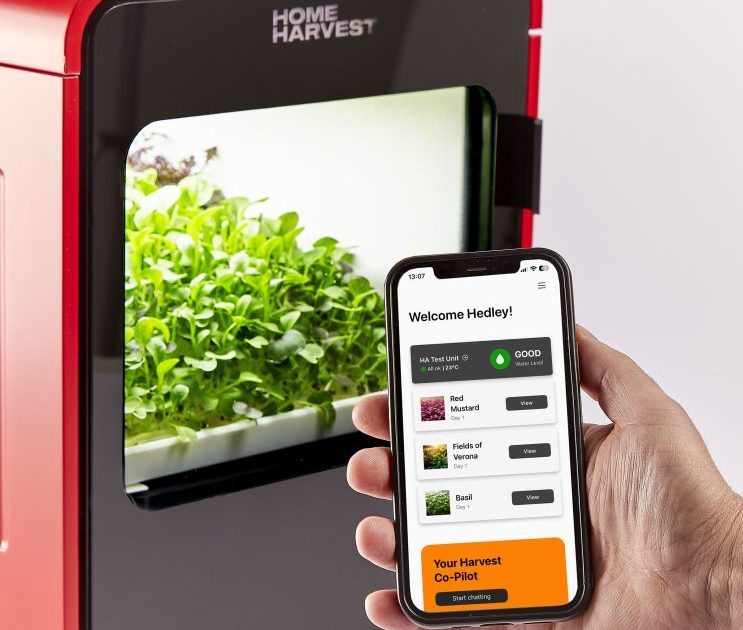
Home Harvest app
The company’s app already supports crop management, recipes and remote monitoring, but the founders outlined far more ambitious plans around AI and personalisation.
“Our supporting app enables AI powered growing, recipes, health and wellness,” says Aylott.
“In the future we plan to utilise AI to monitor the size of crop, check plant health, understand the speed of growth and indicate the best time to harvest.”
The company also envisages the system making dietary suggestions based on consumer needs.
During demonstrations, the founders described how future AI copilots could potentially recommend specific seed mats and growing plans based on factors such as sleep, health goals or nutritional requirements.
Perhaps most strikingly, Aylott suggests the platform could eventually generate an extensive database linking growing behaviour with consumer wellbeing.
“By tracking exactly what a person grows, when they harvest it, and how their biometrics respond, Home Harvest will create the world’s most granular database on ‘Live-Nutrition’ efficacy,” he says.
That vision places the company within a much wider movement in personalised nutrition, where food is increasingly viewed not simply as sustenance but as a tool for preventative health and wellbeing.
Designed for adoption
One of the most notable aspects of the Home Harvest concept is its pricing strategy.
Despite the advanced technology involved, the company has deliberately targeted what it considers a mass-market price point.
The smaller unit is expected to retail at £399, with larger versions available for families or higher-volume users.
The founders repeatedly stressed that affordability was critical if indoor farming technology was to move beyond early adopters and become a mainstream household product.
“We want to get the price low so you drive adoption,” Johnson explains.
“This isn’t a luxury item. This is the staple item that you have in your home.”
The units are also designed for flexibility.
Smaller countertop versions target couples or apartment dwellers, while larger systems are intended for families. Mini heaters built into the units enable operation even in colder ambient environments such as garages or outbuildings.
The company believes this ease of use and accessibility could appeal particularly strongly to younger consumers and families.
“My children love growing,” Aylett notes at the event, reflecting the experiential element of watching crops develop in real time.
At the same time, the founders emphasise that Home Harvest is not intended to be a novelty gardening product.
“The other difference in the market is that you’ve got this massive, plentiful supply,” Johnson says.
“This isn’t like a hobby thing. This is so that the whole family can rely on this.”
Lessons from the Pacific
Perhaps the most compelling demonstration of the technology’s resilience came far away from any kitchen countertop.
Last year, Home Harvest adapted its growing technology for two rowers undertaking a 7,000-mile crossing of the Pacific Ocean.
The modified unit was mounted onto the rowing boat and powered using solar energy, enabling fresh greens to be grown throughout the six-month expedition.
BBC coverage of the challenge documented how the rowers used the system to supplement their nutrition while at sea.
For the Home Harvest team, the crossing became a real-world validation of the technology’s reliability and adaptability.
“It just means that you can grow almost anywhere,” Johnson says.
The Pacific experiment also reinforced one of the company’s broader messages: that decentralised food production may become increasingly important as climate pressures, supply chain disruption and sustainability concerns reshape global food systems.
Reimagining the future of fresh produce
Home Harvest arrives at a time when consumer attitudes towards food are changing rapidly.
 Interest in wellness, sustainability, self-sufficiency and food provenance continues to grow, while rising concerns over waste, pesticide use and supply chain resilience are reshaping expectations around fresh produce.
The company’s founders believe indoor farming technology can respond to all of those pressures simultaneously.
The vision is ambitious: transforming kitchens into miniature controlled-environment farms capable of delivering hyper-fresh produce year-round with minimal waste and limited environmental impact.
Whether consumers fully embrace that vision at scale remains to be seen. But Home Harvest’s approach reflects how food technology companies are increasingly blending agriculture, AI, wellness and connected consumer experiences into entirely new categories.
What once may have sounded futuristic – growing personalised crops inside the home through AI-managed systems – is now edging closer to commercial reality.
Home Harvest’s smart farms are expected to launch initially through Kickstarter pre-orders before wider consumer rollout later this year.
For Johnson and Aylott, however, the goal extends far beyond a single appliance.
The ambition is to redefine what “fresh food” means altogether.
Topics
AI connected living functional nutrition herbs microgreens QR codes salads smart farm
PeopleOrganisationsRegions