Syntegon’s integrated IQF line maximises case density and logistics efficiency
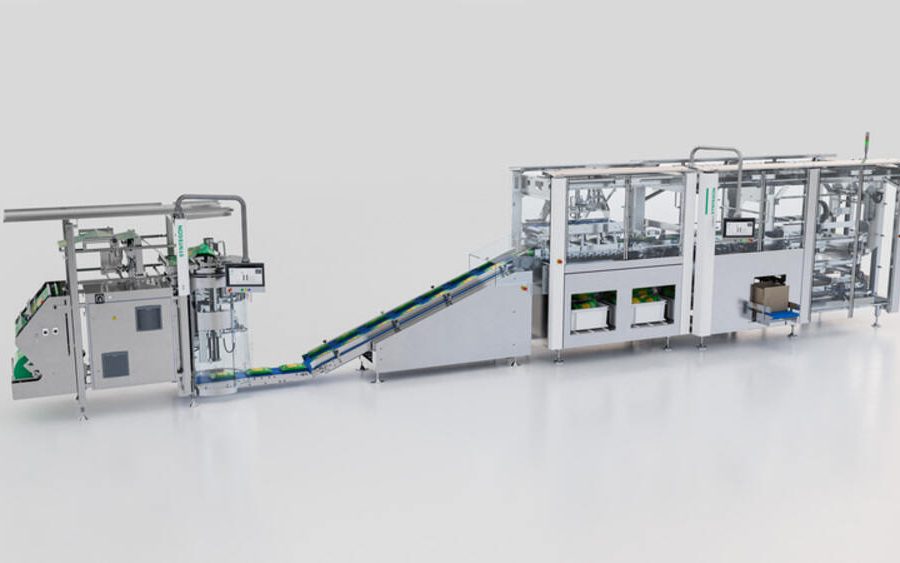
At Interpack 2026, Syntegon is signalling a major shift in frozen food logistics with the global premiere of its integrated SVX Agile and Elematic 4001 line.
By combining high-speed vertical bagging with a gravity-based case packing mechanism, the solution addresses the industry’s most pressing “hidden” cost: the inefficient “shipping of air.”
This launch moves Syntegon from a component supplier to a lifecycle partner, offering manufacturers a single-source architecture designed to meet tightening sustainability regulations and rising throughput demands.
Syntegon is unveiling a fully integrated frozen food line that synchronises the SVX Agile vertical bagger with the new Elematic 4001 gravity case packer. This “bag-to-case” solution is engineered specifically for individually quick frozen (IQF) products, including French fries, frozen vegetables, fruits, and proteins. The system provides a control philosophy across both primary and secondary packaging, managed through a unified human machine interface (HMI).
The frozen food sector faces a unique triad of pressures: maintaining low product temperatures, achieving extreme speeds, and complying with global sustainability mandates to reduce packaging volume. Traditional robotic pick-and-place systems often struggle with the density required for efficient frozen logistics. Syntegon’s solution responds directly to the need for optimised case utilisation, helping manufacturers reduce their carbon footprint and shipping costs by maximising product density per carton.
The line uses core technical innovations to optimise output:
- SVX Agile: a high-performance vertical bagger that forms, fills, and seals pillow bags at industry-leading speeds.
- Elematic 4001 Gravity Packer: utilising a two-level servo-controlled collation and drop station, this unit bypasses traditional robotics to release grouped bags directly into shipping cases.
- The rumbling station: a critical technical feature that redistributes product within the bags prior to loading, ensuring they lay flat and pack tighter, significantly increasing case density.
This line is aimed at large-scale IQF manufacturers and co-packers serving global supply chains. With infeed capacities of up to 120 bags per minute and a loading rate of 25 cases per minute, it is built for high-output environments where operational equipment effectiveness (OEE) and reduced labour training are critical priorities.
Following its debut at Interpack 2026, the system initially launches with horizontal case loading. A modular variant capable of both horizontal and vertical loading is scheduled for the second half of 2026, allowing manufacturers to adapt to varying regional logistics requirements. Syntegon is positioning the line as a lifecycle investment, backed by comprehensive Service Agreements to ensure low total cost of ownership (TCO).
Syntegon’s ambition is to become the integrated line partner for the frozen industry. By harmonising the “look, feel, and touchpoint” of the entire packaging process, Syntegon aims to reduce operator error and troubleshooting time. The goal is to provide measurable efficiency gains that extend beyond the factory floor and into the global logistics network.
For food and drink manufacturers, Syntegon’s integrated approach offers three strategic advantages:
- Unified control: eliminating “mismatched” machinery from different suppliers reduces training hurdles and simplifies data collection for OEE monitoring.
- Gravity over robotics: in the IQF space, gravity-fed drop mechanisms combined with rumbling stations can achieve higher pack densities than robotic arms, directly lowering shipping costs.
- Future-proofing for regulations: as sustainability targets increasingly focus on secondary packaging reduction, the ability to reduce air becomes a competitive necessity rather than a luxury.