Analysis: London Flavour Day – redefining health, sustainability, and sensory recovery
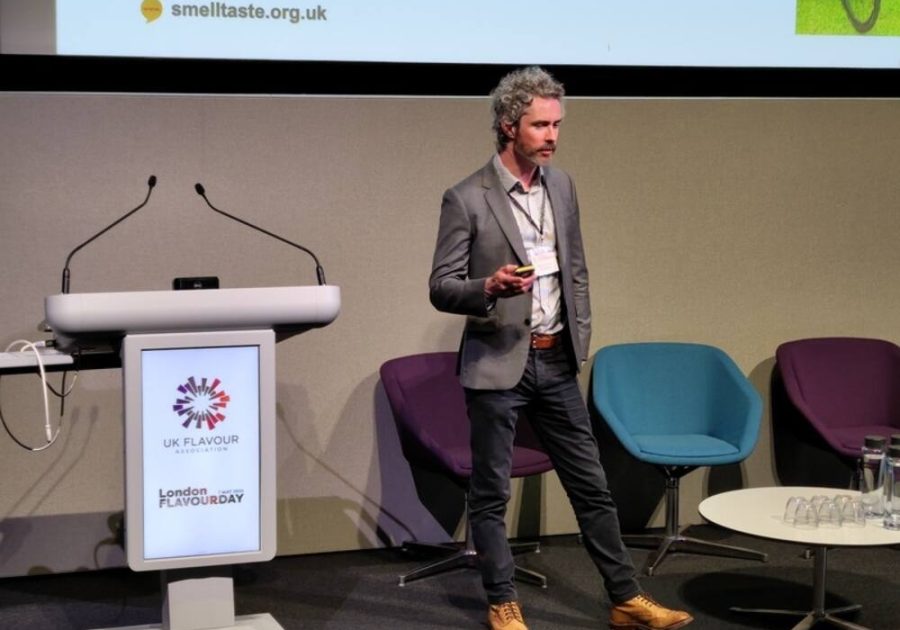
Duncan Boak, chief executive of the charity SmellTaste.
The critical role that flavour plays in everyday life, human health, and global environmental sustainability took centre stage at the 2026 London Flavour Day.
Organised by the UK Flavour Association, the event convened leading researchers and industry figures to explore groundbreaking scientific developments, from digital health and sensory rehabilitation to pan-European consumer trends.
The presentations delivered a clear consensus for food and drink manufacturers: taste is a vital mechanism for driving healthy behavioural changes, sustaining eco-friendly diets, and restoring human well-being.
Overcoming the silent impairment: multi-sensory training via chewing gum
A major focus of the conference was the profound human impact of living without taste or smell. Following an opening address by Duncan Boak, chief executive of the charity SmellTaste — which supports individuals suffering from sensory loss — researchers unveiled a novel, practical approach to sensory rehabilitation.
Dr Nicole Yang, Associate Professor in Flavour Science at the University of Nottingham, presented early data from a pilot study evaluating an innovative “Flavour Integrated Training” (FIT) chewing gum. Unlike conventional olfactory training protocols, which often suffer from low participant engagement and poor adherence rates, the FIT gum is engineered to simultaneously stimulate taste, smell, and trigeminal sensations. By tailoring fruity flavour profiles alongside controlled warming or cooling sensations, the gum offers an interactive, multi-sensory workout for impaired palates.
“This study explores feasibility, user experience, and early sensory outcomes in individuals with flavour impairment, comparing gum-based multi-sensory training with established approaches,” Dr Yang explained. “Findings suggest that chewing gum is a promising format for flavour-led sensory training with strong user acceptability and potential to enhance real-world flavour perception.”
The clinical reality of this research was highlighted by Dr Paul Wicks, a digital health platform innovator who lost his sense of smell and taste after contracting COVID-19 in August 2022. After three years of missing out on “the richness of life in food and drink,” Dr Wicks registered for the University of Nottingham trial. The project effectively bridges the gap between complex sensory science and practical consumer applications, “opening new opportunities for the flavour and food sectors to translate flavour and sensory science into accessible, at-home solutions.”
The secret to sustainable diets: flavour, not willpower
Beyond medical applications, new pan-European research presented at the event reframed the ongoing transition toward sustainable food systems. Jimena Gomez de la Flor from the European Flavour Association shared insights from a comprehensive consumer survey of 6,000 respondents across six European nations, tracking public perceptions of flavourings and taste.
The data revealed a significant gap between consumer intention and long-term behaviour: while the majority of Europeans express a desire to eat more sustainably, very few manage to maintain the lifestyle modification long-term. When respondents were questioned on what would help them remain committed to sustainable choices, the data pointed directly to product formulation. Alongside affordability, good taste was identified by six in ten people as the primary factor required to sustain eco-friendly eating habits over time.
“When we asked people what would help them stay the course and — alongside affordability — taste is the answer,” stated Gomez de la Flor. “Taste isn’t just what sells a product, it’s what makes a sustainable diet stick.”
The research noted that British consumers are among the most “flavour-positive” in Europe, with younger generations actively leading the demand for enhanced taste profiles in sustainable options.
Deconstructing complex formulations for better health
The technical challenges of formulating healthier, satisfying foods were addressed by Laura Wilkinson, Associate Professor in Psychology at Swansea University. Building on research previously introduced at the 2024 Flavour Day, Wilkinson provided an update on the behavioral impacts of multi-component food items (MCFI).
Multi-component food items are defined as single food products processed to combine sensorially distinguishable parts, such as chocolate chip cookies. While these complex formulations are ubiquitous across the modern grocery landscape, scientific literature has historically ignored how the physical configuration of these distinct components alters actual eating behaviour and consumer satisfaction.
“Despite their apparent ubiquity and a sizable research literature on the formulation of such products, there is little research on how MCFI can impact eating behaviour,” Wilkinson noted. “However, our recent work has begun to shed light on how consumers approach eating foods with a complex formulation and crucially, how this can be leveraged for health and sustainability whilst conserving consumer satisfaction.”
Industry evolution and the next generation
The 2026 conference also acted as a commercial platform for the sector’s upcoming workforce, showcasing prize-winning projects from BSc Food Science students at the University of Nottingham.
Reflecting on the successful iteration of the event, Janis Sinton, chair of the UK Flavour Association, highlighted the expanding operational scope of the modern flavour developer. Originally established in 1917 as the British Essence Manufacturers’ Association, the organisation rebranded in 2012 to accommodate a broader corporate membership that today spans 42 companies.
Topics
2026 London Flavour Day digital health MCFI multi-component food items sensory rehabilitation
PeopleDr Nicole Yang Dr Paul Wicks Duncan Boak Janis Sinton Jimena Gomez de la Flor Laura Wilkinson
OrganisationsEuropean Flavour Association SmellTaste Swansea University UK Flavour Association University of Nottingham
Regions