
Quantum Project targets faster, smarter food fraud detection
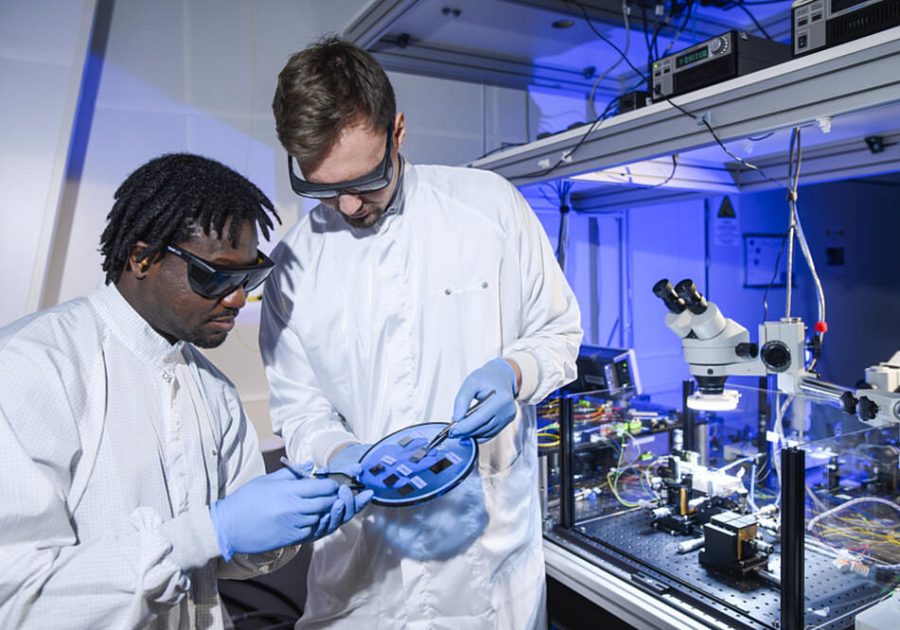
Six partners are working together within the QSPEC project to develop a quantum-based measurement system for food analysis. (Photo: LZH)
Six research and industry partners have joined forces under the QSPEC project to develop a quantum‑based measurement system that could transform how food authenticity is verified — shifting analysis from specialist laboratories to compact, rapid tools suitable for widespread use.
The consortium, funded by the German Federal Ministry for Research, Technology and Space, aims to harness entangled photon pairs to detect adulteration in products such as honey and orange juice, two of the most frequently counterfeited foods globally. By exploiting the complementary behaviour of long‑ and short‑wavelength photons, the system promises a level of sensitivity and precision that conventional spectroscopy cannot match.
A new approach to tackling food fraud
Food fraud costs billions each year and can pose serious health risks. Today, verifying authenticity typically requires complex, time‑consuming laboratory analysis. QSPEC’s goal is to create a compact, cost‑effective quantum spectroscopy system capable of analysing food composition far more quickly.
The six partners — AMO GmbH, Leibniz University Hannover’s Photonic Quantum Technologies group, TOPTICA Photonics SE, AMOtronics UG, the German Institute of Food Technologies (DIL), and Laser Zentrum Hannover (LZH) — are developing the core components:
- novel laser sources for generating entangled photons
- nanophotonic chips integrating quantum‑optical functions
- temperature‑stabilised detection hardware
- reference databases for validating results
Early milestones include successful generation of entangled photon pairs on AMO‑fabricated chips and delivery of two laser systems tuned for quantum frequency combs.
Towards real‑world food analysis
The next phase will see the laboratory system refined into a compact prototype, with DIL benchmarking its performance against established NIR and NMR methods. The long‑term ambition is an industrial‑scale system — and ultimately, technology small enough to be integrated into a smartphone, enabling instant authenticity checks at the point of sale.
The project’s vision is clear: a future where consumers, retailers and regulators can verify what’s really in their food with unprecedented speed, accuracy and ease.