Smart hydrogel packaging gives a real-time freshness signal
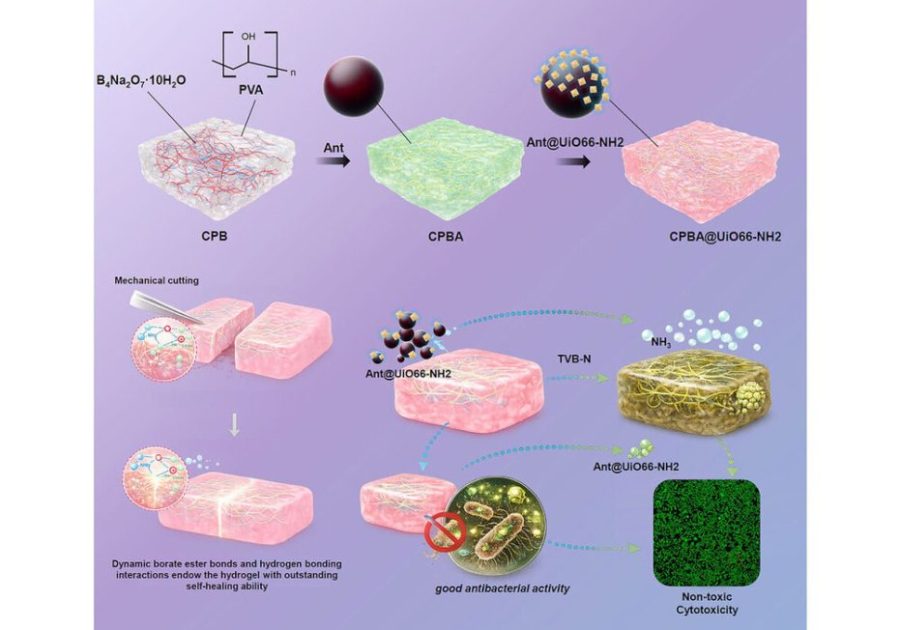
Fig.1. Conceptual illustration of a self-healing smart hydrogel By fixing a natural pigment onto a metal-organic framework, Kyushu University researchers developed a self-healing hydrogel that reliably signals spoilage through colour change while extending food shelf life.
A new generation of “smart” food packaging could allow consumers, retailers and manufacturers to see when food is beginning to spoil without opening the pack, following research by Kyushu University in Japan.
The university researchers have developed a flexible hydrogel film containing a natural plant pigment that changes colour in response to the chemical changes associated with food deterioration. The material is also self-healing, meaning that damage caused during handling or transportation can be repaired, helping maintain the package’s protective barrier.
The technology addresses a longstanding limitation of conventional food packaging: appearance alone does not necessarily reveal the condition of food inside a sealed pack. In meat, for example, bacterial activity breaks down proteins and generates alkaline compounds, causing pH levels to rise before visible spoilage becomes apparent.
The researchers use anthocyanins – natural pigments found in foods such as purple sweet potato and red cabbage – to detect this change. As pH rises, the pigment shifts from purple-red towards yellow-green, providing a visible indication of deterioration.
However, anthocyanins can themselves degrade when exposed to light and heat, potentially making conventional colour-based freshness indicators unreliable. The Kyushu University team addressed this by fixing the pigment onto a metal-organic framework (MOF), a porous material that stabilises the anthocyanin while allowing it to remain responsive to changes in pH.
Xirui Yan, corresponding author of the study, said: “MOFs have attracted enormous attention because of their unique porous structures and versatile functions, and I became curious whether they could be used for something closer to everyday life, like food preservation.”
The stabilised pigment was incorporated into a hydrogel to create a soft, shapeable film that is largely plant-derived and biodegradable. Testing with pork showed that the material changed colour continuously as the meat deteriorated, responding to the accumulation of alkaline gases associated with spoilage.
Importantly for manufacturers, the material is not solely a monitoring device. The researchers found that it also extended the shelf life of pork by around 12 hours compared with untreated samples.
The self-healing property adds another potential manufacturing and logistics benefit. When the film was cut and pressed back together, the damage became almost invisible within minutes, with tensile strength recovering to 99% within two hours.
Professor Fumihiko Tanaka said: “Another interesting thing about this material is that it doesn’t just protect food—it heals itself.”
He added: “In conventional packaging, any crack is permanent and becomes an entry point for bacteria. This material bonds back together on its own. The wound heals, and so does its ability to protect what’s inside, which makes it more durable and reliable in practical use.”
For food manufacturers, the significance lies in the potential convergence of several packaging functions. Rather than using separate technologies for physical protection, shelf-life extension and freshness monitoring, the hydrogel is being developed as a multifunctional material capable of performing all three roles.
The approach could also provide manufacturers and logistics operators with better visibility of product condition across the supply chain. The research team is already exploring a smartphone application that could allow manufacturers, logistics companies and consumers to assess food quality in real time.
That could eventually move freshness monitoring beyond a simple visual indicator towards a more connected packaging system, in which information generated by the pack can be interpreted digitally.
The development also fits the wider move towards packaging materials that combine performance with lower environmental impact. The hydrogel is based largely on plant-derived material and is designed to be biodegradable, while the anthocyanin itself comes from an agricultural source.
The research remains at the development stage, however, and further work will be required before such materials can be adopted commercially at scale. Food-contact safety, manufacturing consistency, cost, compatibility with existing packaging lines and performance across different food categories will all be important considerations.
Nevertheless, the research points towards a future in which packaging does more than contain and protect food. It could actively monitor product condition, respond to damage and provide manufacturers with a clearer picture of freshness throughout the supply chain.
As Fumina Tanaka, associate professor at Kyushu University, put it: “Smart materials built from natural ingredients and nanotechnology may have uses we haven’t imagined yet.”