New line brings sardine success
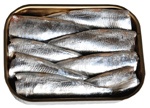
 Getting sardines neatly arranged in a can sounds as though it should be simple enough – but, in reality, it involves an advanced technological process, says Cabinplant.
The production of canned sardines has traditionally consisted of three stages. The sardines are sorted according to size in one machine, then the head and tail are removed and the entrails sucked out in another. Finally, the sardines are packed by hand.
However, this process is now a thing of the past, says food machinery firm Cabinplant, thanks to its new robot trimming and packing line, which has converted these three stages into one continuous process.
So how does it work?
“The sardines are placed on a conveyor and pass under a camera that photographs each individual fish,” explains a spokesman for Cabinplant. “A powerful processor calculates where to cut each individual sardine and the area of the piece that is to go in the can.
“A cutting edge and vacuum suction remove the head, tail and entrails, so that only the section for packing remains. Based on their weight, the sardines are then sorted by size and matched up so that the desired total weight of the can is achieved as precisely as possible. At the same time, the sardines are easier to pack and look nicer too. They are packed in can in the traditional crossways manner.”
The new line – a tailored solution – has been developed in close cooperation with Greek producer North Aegean Sea Canneries.
“We began development three years ago in close cooperation with the customer, which also helped with co-financing,” adds the spokesman. “First of all came a prototype that had one camera and one robot. This was meticulously tested by North Aegean Sea Canneries and was subsequently developed into two machines, each with seven robots and a camera, for the Greek customer.”
Cabinplant has been granted with a patent for the robot trimming and packing line in the US, however the patent is still pending in Europe.