Food value factory to turn Dutch Fresh Port side streams into revenue

With €1.5 million committed in its 2027 budget, the Dutch province of South Holland is scaling a collaborative, data-driven hub to keep surplus produce in circulation and help entrepreneurs valorise by-products.
Tackling a persistent supply chain leak
Despite incremental progress in recent years, food loss remains a stubborn structural challenge across the Netherlands. According to Wageningen University figures cited by the province, more than 2 billion kilogrammes of food were lost in the Netherlands in 2023 — roughly 127 kilogrammes per resident.
Rather than treating food waste strictly as an end-of-pipe disposal issue, South Holland is targeting the front end of the supply chain. The province’s concentration of port logistics, potato cultivation, greenhouse horticulture, distribution, and processing creates dense proximity between suppliers and buyers.
Around Dutch Fresh Port — the fresh-produce cluster spanning Barendrecht and Ridderkerk — importers, producers, wholesalers, and processors generate roughly 55 million kilogrammes of surplus and by-product streams every year.
To capture that value, the province allocated €1.5 million in its 2027 budget (adopted on November 11, 2026) to scale the Food Value Factory around Dutch Fresh Port.
Connecting entrepreneurs, data, and markets
Crucially, the Food Value Factory is not a single physical plant. Instead, it operates as a collaborative ecosystem — linking physical aggregation with digital matching — to help entrepreneurs find commercial and social outlets for surplus streams.
Using data and artificial intelligence to track product volumes, quality, and availability, the hub aims to align supply with downstream demand. Where surplus fruit, vegetables, and processing side streams once risked being written off, entrepreneurs can divert them into secondary value chains — such as juices, lemonades, non-alcoholic beer, soups, purees, animal feed, or compost — while channelling suitable volumes toward social initiatives including food banks, SharEaty, and neighbourhood restaurants in Rotterdam.
The initiative builds on provincial food-waste work dating back to 2018 and brings together the municipalities of Barendrecht, Ridderkerk, and Rotterdam, the Nieuw-Reijerwaard joint arrangement, and cluster operators. Seven founding partners have united under the DFP Regie Coöperatie, with active participation from Fruitful Ventures (including Olympic Fruit and living lab Half Baked) and advisory input from Rabobank.
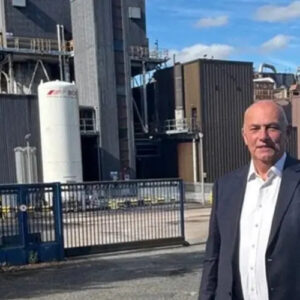
“We waste 2 billion kilos of food in the Netherlands every year. That is not only an enormous shame from a moral and sustainability perspective, but also from an economic one. Countering food waste is therefore logical, necessary, and sensible,” said Robert Tieman, provincial executive for Food, Province of South Holland
Tieman emphasised that the funding is designed to unlock commercial and institutional linkages rather than physical plant construction: “We are not investing in a factory, but in the connection between entrepreneurs, knowledge, data, and markets. Preventing waste is central, not processing it.”