A fresh take on growth
Food and beverage manufacturers are being asked to solve several challenges at once. Products must be safe and high quality, yet affordable. Recipes need to become more natural and diverse, while consumers expect convenience and clean labels.
Supply chains need to reach further, even as costly refrigeration, energy use, food waste and carbon emissions face closer scrutiny. At the same time, manufacturers need production systems that can handle more products, more formats and more frequent changeovers without sacrificing efficiency.
Aseptic technology sits at the intersection of these demands. It can be condensed to one simple offering: long product shelf life at ambient temperature. In reality, successful aseptic technology is a carefully engineered system in which product treatment, packaging sterilisation, filling technology, sealing, packaging materials and operational services must work together. This is where specialist expertise makes the difference

Hanno Geissler, head of technology services at SIG.
“Aseptic is not just a filling step and it is not just about a package. It is a complete system designed to protect the product from processing through to consumption,” says Hanno Geissler, head of technology services at SIG. “The real challenge is to maintain commercial sterility while also protecting taste, texture, colour and nutritional value, and doing so consistently at industrial scale.”
More than shelf stability
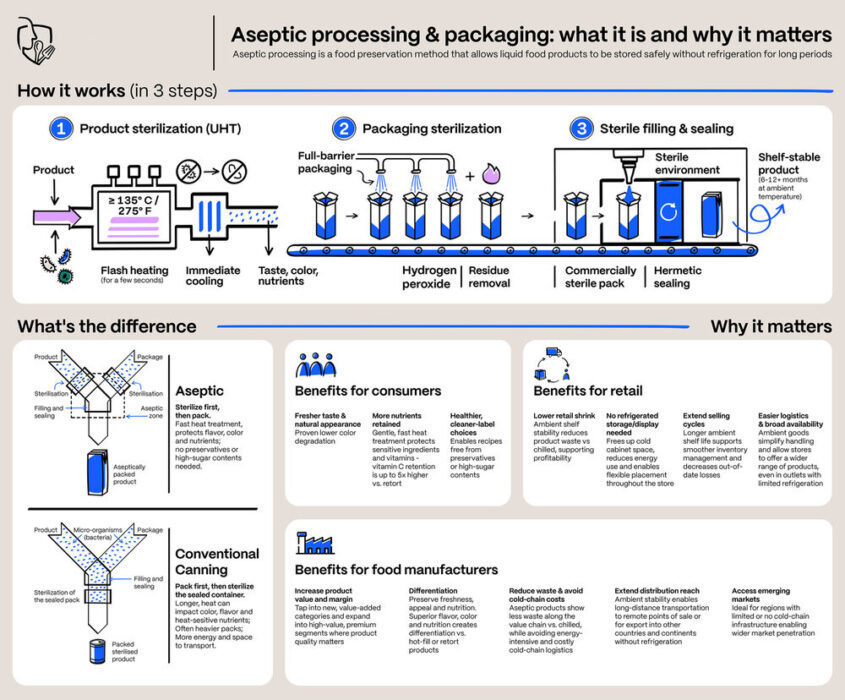
Aseptic technology is based on a clear principle: the products and the packaging are sterilised separately before they are brought together under controlled sterile conditions. The product typically undergoes rapid high-temperature treatment and immediate cooling, while the packaging is sterilised and prepared for filling. The sterile product is then filled into the sterile pack and hermetically sealed.
This differs fundamentally from conventional retort or canning processes, in which the product is sterilised after it has already been packed. Because retort processing exposes the entire filled pack to heat for longer, it can have a greater impact on heat-sensitive product characteristics. Aseptic processing, by contrast, uses a very short thermal treatment before filling, helping manufacturers deliver shelf-stable products with a fresh-like sensory profile and strong nutritional quality, without the need for preservatives or refrigeration.
Aseptic processing and packaging.
For manufacturers, ambient shelf stability can open access to longer distribution routes and markets where cold-chain infrastructure is limited. It can simplify inventory management, reduce dependence on refrigerated logistics and help lower losses across the supply chain. Retailers gain greater freedom in how and where products are merchandised, while consumers benefit from convenient products that can be stored at home and consumed when needed.
Manufacturers need flexibility
Manufacturers are faced with the fact that the food and beverage market is moving beyond pure liquids. What’s in demand are products with perceptible added value and differentiated textures: dairy and plant-based beverages, premium juices, drinkable snacks, wellness shots, soups, sauces and other food and beverage products containing value adding fibres and pieces.
SIG’s high-speed and highly flexible aseptic carton filling machines for beverages are designed to handle a wide range of product types on the same equipment, including liquid dairy, plant-based beverages, juices, nectars, still drinks, ready-to-drink coffee and tea, nutritional drinks, and even alcoholic beverages like wine. Its sleeve-based filling technology individually shapes, sterilises and fills each carton sleeve. The pack is then ultrasonically sealed above the filling level rather than through the product. This open-sleeve filling process contributes significantly to a high level of aseptic safety and forms the basis for a high degree of flexibility in terms of product variety.

SIG Drinksplus technology is designed for beverages containing chunky ingredients.
Specialised solutions like SIG Drinksplus extend the possibilities for beverage manufacturers further by enabling the inclusion of eg fruit, vegetable and nut pieces or cereal grains and filling the products on standard filling machines for beverages. The technology is designed for beverages containing chunky ingredients up to 10 per cent, particulates up to 6x6x6 millimeters, and viscosities up to 1,000 mPas. These capabilities give manufacturers more ways to create distinctive products without abandoning the aseptic safety and shelf-life advantages of aseptic packaging.
Beyond that, SIG’s aseptic food filling technology is designed to handle liquid, viscous and chunky food products on the same filling machine.
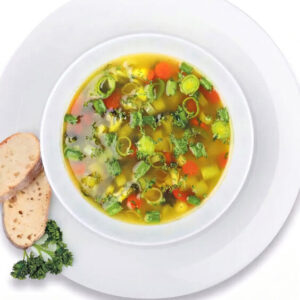 The SIG food filling systems can accommodate food products with particulates up to 25 millimeters, fibre lengths up to 40 millimeters and solid content up to 50 per cent, depending on the relevant machine and package solution. For products that require more precise control of the product components, SIG’s two-phase filling technology can dose ingredients and carrier liquid separately. This is particularly useful for products such as low-viscosity soups containing larger vegetable pieces, where a viscous carrier can first transport the particulates before additional liquid is added to achieve the desired final consistency.
“The opportunity of aseptic technology is not simply to make an existing product shelf-stable,” Geissler explains. “It is to use aseptic technology as a platform for innovation: to bring value-adding ingredients, new textures for new consumption occasions to market while keeping product safety and quality at the centre.”
Aseptic across three packaging platforms
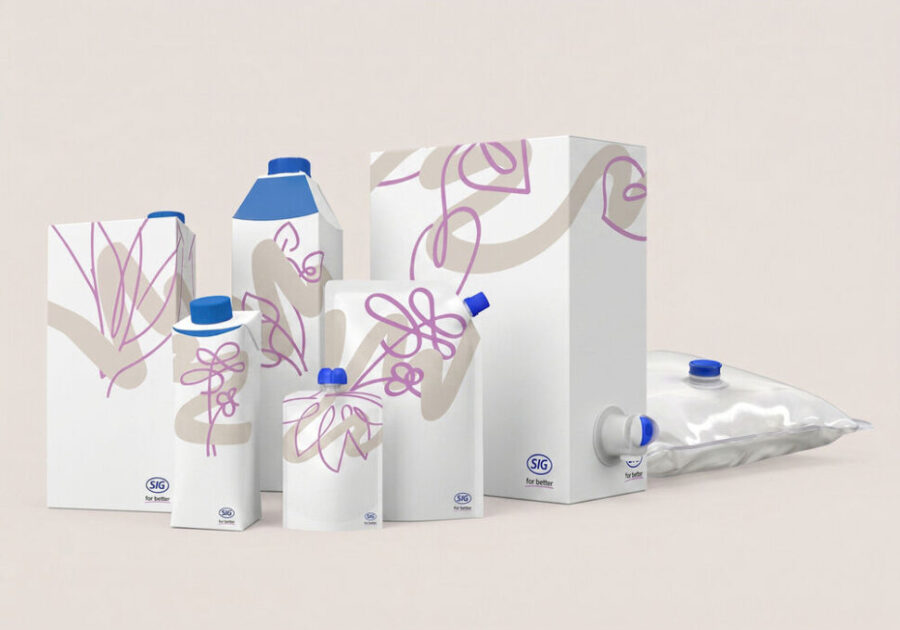
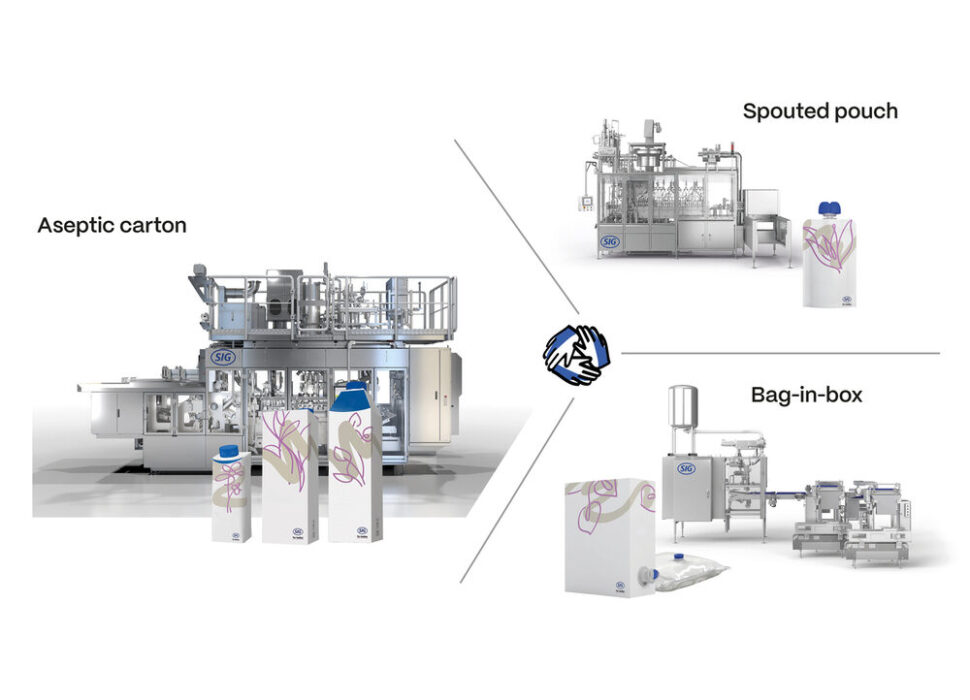
SIG’s distinctive position is that it applies aseptic expertise across three key packaging types: carton, bag-in-box and spouted pouch. This breadth matters because no single format answers every product, channel or consumption occasion.
In aseptic carton, SIG offers complete systems for products like liquid dairy and plant-based drinks, non-carbonated soft drinks and liquid food products. Its open-sleeve filling technology supports flexibility in products, format, volume and design, while filling equipment can reach outputs of up to 32,000 packs per hour.
Aseptic technology and packaging across substrates.
In spouted pouch, SIG’s aseptic spouted pouch system featuring in-line sterilisation is unlocking new growth spaces in food and beverages. Combining all the benefits associated with aseptic products with the high convenience, portability, squeezability, and very material-efficient design of spouted pouches, offers a suitable packaging solution for modern consumers. The SIG Prime 55 In-Line Aseptic, for example, sterilises pre-made pouches directly within the filling machine. This removes the need for third-party pre-sterilization and gives manufacturers an integrated route to aseptic pouch filling, from market-entry volumes through to high-output manufacturing.
In bag-in-box, SIG’s aseptic-capable filling equipment supports multiple applications, eg foodservice. The SIG SureFill 42 Aseptic, for example, is a high-performance, automated, web-fed bag-in-box filling machine for packages up to 30 litres designed to meet the demands of retail through foodservice and institutional product production. With its robust construction, the SIG SureFill 42 delivers efficient and reliable filling for a wide variety of liquid products. It combines the efficiency of bag-in-box with the protection offered by aseptic technology and packaging.
Together, these packaging systems allow manufacturers to choose the solution that best fits the product and route to market, while working with one packaging systems partner across their wider portfolio.
Engineering the whole system
Aseptic performance depends on much more than the speed of a filling machine. Manufacturers must also manage sterilisation, cleaning, changeovers, waste rates, operator training, maintenance and the ability to scale production as demand evolves. SIG therefore combines filling equipment with packaging materials, as well as technical and digital services as integrated packaging system solutions.
That system solutions approach is increasingly important as manufacturers look for lower operating costs and more resilient production. Faster format, pack size and product changeovers can improve filling line utilisation. Low waste rates and pack size to price point adaptability help protect margins and resources. Automated cleaning and intuitive human-machine interfaces can reduce operator burden while supporting consistent performance.
“Aseptic technology rewards precision,” says Geissler. “Every element has to be engineered around the product, the package and the process. Our role is to help manufacturers translate that complexity into a reliable, flexible and commercially viable production system.”
The result is a broader definition of aseptic competence. It is not only the ability to fill a sterile product into a sterile pack. It is the ability to protect product quality, expand into white spaces, simplify distribution and support efficient production across multiple product and packaging options. For manufacturers navigating a more demanding food and beverage market, that combination makes aseptic technology not merely a preservation method, but a platform for growth – and positions SIG as an aseptic powerhouse ready for what comes next.
Topics
aseptic bag-in-box cartons clean label convenience filling spouted pouch sterilisation
PeopleOrganisations