UK Packaging Pact to revolutionise standards
WRAP has officially launched the UK Packaging Pact, a landmark ten-year collaborative programme designed to fundamentally transform the UK’s packaging system.
Succeeding the world-first UK Plastics Pact, this new voluntary agreement expands its scope beyond plastics to include all packaging materials — glass, paper, card, metal, and bio-based materials — placed on the market.
With almost 100 founding signatories including major retailers like Aldi, Sainsbury’s, Tesco, and Lidl, and FMCG giants like Unilever, Danone, and Muller, the Pact arrives at a critical juncture for the food and drink trade. It is designed to act as a “unified system approach” to help businesses navigate a rapidly changing regulatory landscape, including Extended Producer Responsibility (EPR) and the Deposit Return Scheme (DRS).
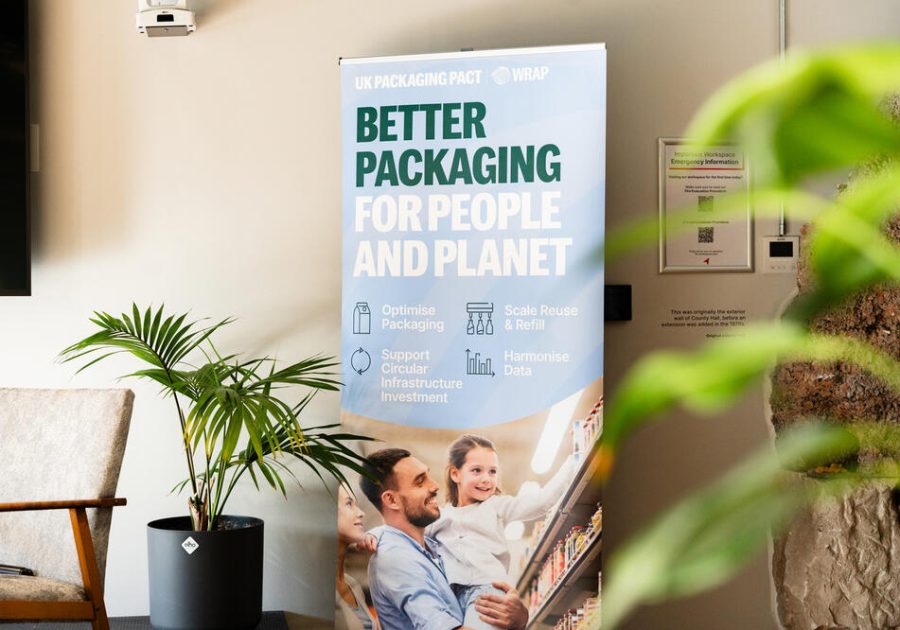
Four strategic goals for a circular economy
The Pact is built around four interconnected pillars that will guide industry action through 2035:
- Optimise packaging: a focus on eliminating single-use and problematic materials, “right-weighting” designs, and increasing recycled content — particularly for plastic and glass.
- Scale reuse and refill: driving standardised, interoperable systems to move the market away from single-use models.
- Support Infrastructure Investment: building a reliable evidence base to unlock funding for UK recycling and reprocessing infrastructure, addressing current bottlenecks like non-recyclable multi-material films.
- Harmonise data: simplifying reporting requirements by aligning UK and EU standards to reduce the data burden on businesses.
Navigating regulatory storms
The launch follows stark warnings from WRAP and the World Bank regarding spiralling global waste. Catherine David, CEO of WRAP, emphasised that while policies are essential, they cannot deliver change alone.
“The Packaging Pact will deliver the practical change necessary through a flexible framework,” David stated. “Today, we begin to unlock progress – to reduce business costs, to mitigate against risks, and to prepare for the future.”
For food and drink producers, the Pact offers an exclusive mechanism to influence and shape upcoming government reforms. By participating in pre-competitive collaboration, signatories can:
- Reduce EPR fees: through smarter design and material reduction that lowers tax burdens
- Future-proof operations: Aligning with evolving UK and EU regulations before they become mandatory.
- Cut emissions: packaging accounts for approximately 3% of the food sector’s total emissions; the Pact provides a roadmap to drive this toward net zero.
The roadmap to 2035
The first year of the Pact will focus on identifying material reduction opportunities and providing policy advice to incentivise investment in critical recycling infrastructure. This activity will lead to the publication of a Definitive Packaging Roadmap in early 2027.
The ultimate vision, according to WRAP, is to fill the “Supermarket of 2035” with products in minimal, efficient packaging designed for reuse, ensuring that every item bought is recovered and never wasted.
“Large parts of the UK’s recycling markets have been failing for the past decade due to poorly designed composite packaging. The UK Packaging Pact has a clear opportunity to identify real opportunities for investment in better packaging and more UK recycling infrastructure,” Dan Cooke, director of policy at CIWM.
The official rollout marks a major step forward for the Food & Drink Federation (FDF) and British Retail Consortium (BRC), both of which are founding supporters of the initiative.