Cranfield University cracks egg protein with fungi
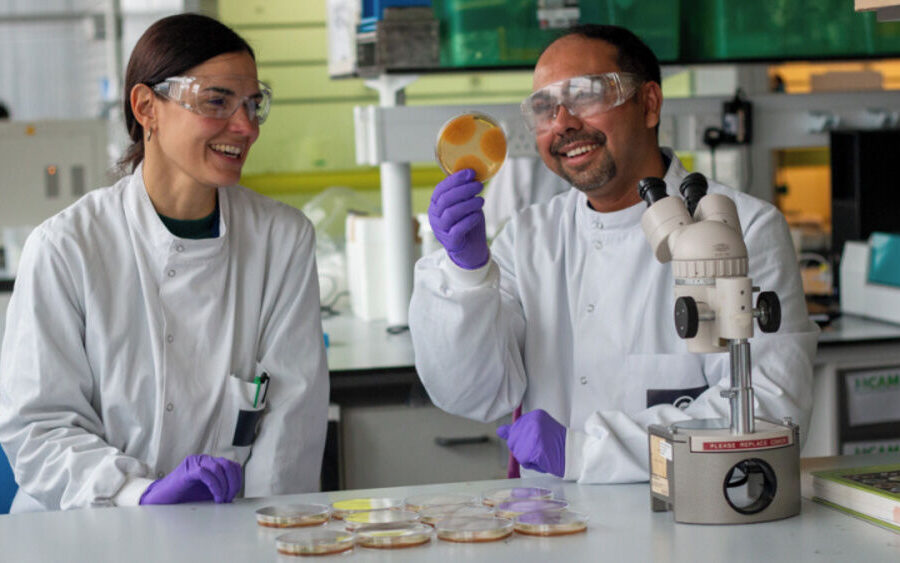
Dr Carla Cervini and Dr Abhishek Baghela. Image: Cranfield University.
Cranfield University researchers are investigating whether naturally occurring fungi can produce ovotransferrin, a valuable protein found in chicken eggs, without the need for chickens.
A protein under pressure
Ovotransferrin is a protein found naturally in egg whites. According to Cranfield, it has antimicrobial and iron-binding properties and is used in products such as dietary supplements and functional foods.
Production currently relies on chicken eggs, which means supplies can be affected by factors such as bird flu outbreaks, rising costs and environmental pressures. The university says exploring alternative production technologies could complement established farming systems and help to build a more resilient and sustainable supply.
Fungi in the fermenter
The project uses filamentous fungi, which Cranfield notes are already widely used in biotechnology to produce useful ingredients. The team will work with specially engineered fungal strains to determine whether they can produce ovotransferrin through precision fermentation.
The fungi are grown in controlled tanks, where they act as “tiny protein factories”, producing the protein without the need for chickens. The aim is to establish a proof-of-concept production process that could provide the foundation for future scale-up and commercial development.
A partnership built on mycology
The project is funded by the National Alternative Protein Innovation Centre (NAPIC) and brings together researchers from Cranfield University’s Magan Centre of Applied Mycology (MCAM) and biotechnology company HyphaPro.
It is led by Dr Abhishek Baghela, senior lecturer at Cranfield University, with support from Dr Carla Cervini, lecturer at Cranfield University, in collaboration with Dr Andrew J. Foster, director of HyphaPro.
Dr Baghela said: “As demand grows for sustainable ingredients, we need to explore new ways to produce valuable proteins without putting additional pressure on our traditional food systems.”
He added: “Through this project we aim to demonstrate the potential of fungal precision fermentation to manufacture high-value functional ingredients. It’s an exciting opportunity to bring together fungal biotechnology and food sciences to develop new approaches for the alternative protein sector.”
Supply resilience
For manufacturers of the dietary supplements and functional foods in which ovotransferrin is used, the attraction set out by Cranfield is supply resilience. An egg-based supply chain is exposed to bird flu outbreaks, rising costs and environmental pressures; a fermentation-based route would not rely on chickens at all. Cranfield positions the approach as a complement to established farming systems rather than a replacement for them.
If the proof of concept succeeds, it could provide the foundation for future scale-up and commercial development. Cranfield also says the approach could extend to producing other high-value proteins, a prospect that would widen its relevance beyond a single ingredient.