Brightest minds in food engineering gather at European workshop
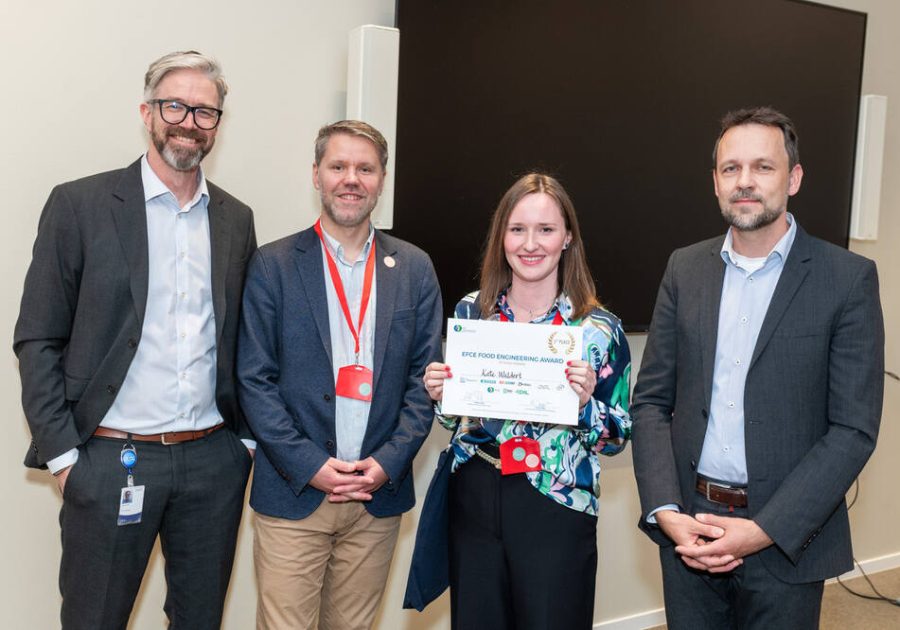
From the left: Dr Johan Agrell, strategic business development manager, Alfa Laval, Dr Kemal Aganovic, Professor at DIL Deutsches Institut für Lebensmitteltechnik e. V., Dr Kate Waldert, BOKU University and Dr Henry Jäger, Professor at BOKU University.
Some of Europe’s most promising young researchers in food engineering and technology convened at Alfa Laval’s Flemingsberg facilities for the 19th European PhD Workshop on Food Engineering and Technology — an annual event designed to accelerate scientific exchange and strengthen collaboration between academia and industry.
Held on April 28–29 and organised by the Food Section of the European Federation of Chemical Engineering (EFCE), the workshop brought together 19 PhD candidates and recent postdoctoral researchers from across Europe, accompanied by their supervisors. Over two days, participants presented cutting‑edge research, debated emerging challenges, and built connections with leading industrial partners.
Supported by an industry board including Alfa Laval, Bühler, Elea, GNT, Nestlé and Yili, the event underscored the importance of cross‑sector collaboration in addressing global food‑system pressures. For Alfa Laval, hosting the workshop reflects its commitment to working closely with academia to develop technologies capable of feeding a growing population.
“We are proud and delighted to have welcomed such a knowledgeable and dedicated group of researchers,” said Johan Agrell, strategic business development manager at Alfa Laval. “Engaging with young talent is essential to advancing innovation, and this workshop created a valuable space for collaboration, learning, and the exchange of new perspectives between academia and industry. The industry faces significant challenges ahead in meeting global food demand, and we can only succeed by fostering the development of future talent and pioneering solutions in processing technology.”
A highlight of the event was the presentation of the EFCE Food Engineering Awards, recognising outstanding scientific contributions. First prize went to Kate Waldert of BOKU University, Austria, for her research on tailored design for ohmic baking of wheat bread. Second place was awarded to Felix Ellwanger of Karlsruhe Institute of Technology, Germany, for his work on the mechanistic understanding of twin‑screw extrusion of plant proteins. Third prize was shared by Julia Baumgartner of ETH Zürich, Switzerland, for her analysis of microalgal lipid droplets as functional food ingredients, and Koen Wetterauw of Wageningen University, The Netherlands, for his mechanistic foundation for dry fractionation.
Henry Jäger, professor at BOKU University and co‑chair of the workshop, praised the calibre of the participants. “This year the standard of research and the talent of those participating was extremely impressive with a diversity which highlighted the variety and breadth of the challenges ahead. The quality of the research entries shows that the study of food engineering and technology is in good hands as we head into the future.”
Since its inception in Germany in 2007, the European PhD Workshop on Food Engineering and Technology has travelled across the continent. Its latest edition in Sweden continues the tradition of bringing together the brightest minds to shape the future of global food production.