Matching air to demand
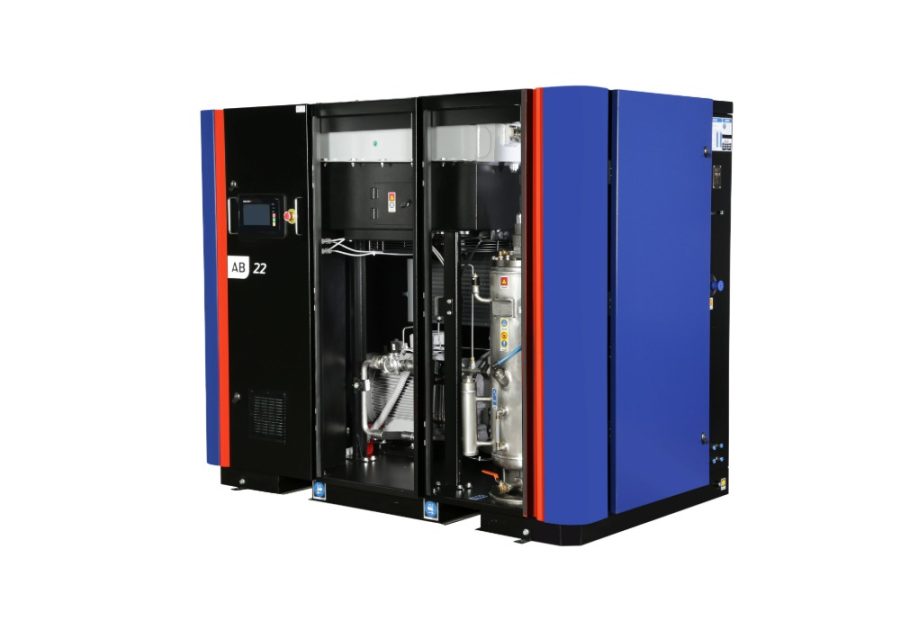
ELGi’s new Demand=Match system, unveiled earlier this year in Stratford‑upon‑Avon, aims to solve one of the most persistent inefficiencies in compressed‑air generation.
Food & Drink Technology sat down with Niccolò Casini, ELGi’s senior director for product management, to explore how this patented technology could reshape compressed‑air strategy for food and beverage producers.
Compressed air has long been considered the fourth utility in manufacturing — as fundamental as electricity, water, and natural gas. In food and beverage production, it is everywhere: powering filling and capping lines, driving pneumatic conveyors, supporting sorting and mixing systems, and enabling the precision of modern packaging and quality‑control equipment. Yet unlike the other utilities, compressed‑air demand is rarely stable. Production lines accelerate, slow, pause for changeovers, or run at partial load. Batch processes fluctuate hour by hour. Seasonal peaks and troughs reshape consumption patterns.
Despite this inherent variability, most facilities still rely on fixed‑speed compressors that deliver a constant output regardless of what the plant actually needs. ELGi’s own data shows that around 70% of compressors in use today are fixed‑speed units. As the company’s briefing document notes, these machines “produce constant air output even when demand varies” and “operate within defined pressure limits and cannot respond dynamically.” The consequences are familiar to any engineer responsible for compressed‑air systems: wasted energy, pressure overshoot, excessive cycling, and premature wear on components.
For food and beverage manufacturers — where uptime is critical, hygiene standards are stringent, and sustainability targets are tightening — this mismatch between supply and demand is becoming increasingly costly.
Earlier this year, ELGi presented a new solution designed to address this long‑standing inefficiency. The Demand=Match system, a patented technology that adapts compressor output to real‑time plant requirements, was introduced to the UK market at an event in Stratford‑upon‑Avon earlier this year. The launch marks a significant shift in how fixed‑speed compressors can operate, offering a middle ground between traditional fixed‑speed machines and more complex variable‑speed drives.
A mismatch decades in the making
When asked to explain the core problem Demand=Match is designed to solve, Niccolò Casini does not mince words. “It’s incredibly rare that you have a fixed‑speed compressor and a fixed‑speed demand of compressed air,” he says. “Across your plant, not only one application but across your plant, you almost never consume the same amount of air. That’s quite unrealistic.”
This mismatch forces fixed‑speed compressors into a cycle of constant starts and stops as they attempt to maintain pressure. The compressor runs at full output, fills the system, hits its pressure limit, shuts off, and then restarts when pressure drops. The process repeats endlessly throughout the day.
Casini explains the consequences: “You waste energy because it’s not efficient to have the compressor start and stop. In average, it will work at a pressure a little bit higher than what is needed, and this costs money. Energy is pretty expensive in the UK and Europe.” The mechanical impact is equally significant. “All this start and stop boosts a lot of stress on specific components… you might reduce the lifetime of these components and have the compressor at the end have a failure.”
For food and beverage producers, where compressed air often touches packaging materials or product‑contact surfaces, reliability is non‑negotiable. A compressor failure can halt filling lines, disrupt packaging operations, and lead to costly downtime.
Variable‑speed drives: effective but not always suitable
Variable‑speed drive (VSD) compressors were introduced to address this problem by adjusting motor speed to match demand. They are widely used in Europe, where energy prices are high and grid stability is strong. But VSDs are not a universal solution.
Casini outlines the barriers clearly. “To buy a variable‑speed compressor, you need to spend around 40% more versus a fixed‑speed,” he says. “If you are a small or medium company… you might say, ‘I prefer to buy a fixed‑speed compressor.’” Environmental conditions can also be a challenge. “If you have dust or humidity or problems in your grid… variable‑speed drives are pretty sensitive.”
For many food and beverage manufacturers — particularly those with older facilities, fluctuating power quality, or limited capital budgets — VSDs are simply not the right fit.
This is the gap ELGi set out to fill.
A new middle ground: how Demand=Match works
Demand=Match is designed as a **capital‑light, adaptive alternative** that delivers many of the benefits of VSD technology without the cost or complexity. Instead of varying motor speed, the system uses internal air recirculation to modulate output.
Casini explains the principle: “The compressor always works at the same speed, exactly the same as a fixed‑speed compressor. But we have two internal valves and two cycles of recirculation that we can open or close or partially open, to match at the output the demand.”
Rather than sending all compressed air to the plant, the system intelligently redirects a portion of the air back into the compressor when demand drops. This allows the machine to maintain stable pressure without cycling on and off.
A demonstration video shown at the Stratford‑upon‑Avon event illustrated the effect vividly. With Demand=Match disabled, the compressor’s piston cycled rapidly as the machine repeatedly hit its pressure limit. When the system was enabled, the piston remained steady, the cycling stopped, and the compressor delivered only the air required.
The result is a fixed‑speed compressor that behaves like an adaptive system — without the electronics, sensitivity, or cost of a VSD.
Real‑world savings and performance gains
Early field results are promising. One facility reduced energy use from 21 kWh to 17 kWh, achieving a 17% reduction. Another cut load cycles from 28 per hour to just four, significantly reducing mechanical stress. Multiple users reported improved stability, reliability, and equipment life.
Casini confirms that these results are consistent with ELGi’s broader testing. “We tried it at a customer in the UK, and they registered 16% savings,” he says. “In a real‑life application, it’s improving reliability… reducing downtime.”
For food and beverage manufacturers — where compressed air can account for a substantial share of total energy consumption — these savings translate directly into lower operating costs and reduced emissions.
Why manufacturers stand to benefit
Food and beverage operations are characterised by frequent changeovers, fluctuating production speeds, and a mix of continuous and batch processes. These conditions create exactly the kind of variable demand profile that Demand=Match is designed to handle.
The technology is already supporting quality‑sensitive operations in Europe, including wine production and flour milling, where stable, oil‑free compressed air is essential for protecting product quality. While Demand=Match currently applies to oil‑lubricated compressors, Casini suggests that integration with oil‑free systems — including ELGi’s water‑injected AB Series — is part of the long‑term roadmap. “That’s probably the future,” he says. “Right now the big bulk of potential is in the oil‑lubricated market… but in future that’s the idea.”
A strategic shift in ELGi’s portfolio
As part of its commitment to improving energy efficiency, ELGi will discontinue fixed‑speed compressors in the premium 11–45 kW range. The company frames this as a responsibility to customers, ensuring that new installations deliver measurable efficiency gains.
Demand=Match is available as a factory‑fit option on selected EG and EQ series compressors, with suitability across automotive, textiles, electronics, pharmaceuticals, general engineering, and — critically — food and beverage.
A practical first step: audit before you invest
When asked what advice he would give to food and beverage manufacturers reviewing their compressed‑air strategy, Casini’s answer is refreshingly candid.
“Check for leaks in your system,” he says. “An audit is always the first step.”
He acknowledges that this advice “goes a little bit against my interest as a compressor manufacturer,” but insists that it is the right starting point. “Sometimes it’s not that the compressor is not big enough… you might have leaks that you don’t hear or see. One millimetre leak is already leaking a lot of air, 24/7.”
Only once the system is optimised should manufacturers consider upgrading equipment — and for many, Demand=Match may offer the most cost‑effective path to improved performance.
A technology built for real‑world manufacturing
Demand=Match is not a theoretical innovation. It is a practical response to the realities of modern manufacturing: fluctuating demand, rising energy costs, sustainability pressures, and the need for reliable, robust equipment.
Casini summarises the company’s ambition succinctly. “We want to increase the pool of customers that can afford an energy‑saving solution,” he says. “Instead of saying either you get the best possible thing or nothing, we bring a middle range to enable access to energy savings to a bigger pool of customers.”
For food and beverage manufacturers, the message is clear. Compressed air may be the fourth utility, but it no longer needs to be the most wasteful. With Demand=Match, ELGi is offering a new way to align air supply with real‑world demand — and in doing so, helping producers cut costs, reduce emissions, and improve operational stability.
Topics
capping compressed air compressors conveyors filling Mixing quality control sorting variable speed drives VSDs
PeopleOrganisations