Danone’s Milk Academy: future-proofing dairy through farmer resilience
When Danone announced the launch of its Milk Academy, the move was framed not as a pilot experiment but as a strategic cornerstone of its global dairy operations. For Olivier Verdelet, vice president of cycles and procurement at Danone, the Academy is both a response to urgent pressures and a proactive investment in the future of dairy farming.
“We are operating in a significant period of flux for dairy,” Verdelet explains. “Consumer demand for dairy products is rising, yet climate volatility, evolving policy and economic pressures are redefining what it means to be a farmer. To safeguard our future supply and food sovereignty, we must support farmers to adapt by collectively rethinking how we source and manage our operations.”
A cornerstone of strategy
The Milk Academy is designed to bring together academic expertise, technical innovation, and Danone’s own operational know-how into a single programme. Verdelet describes it as “capability building at farm level” — a lever to safeguard local food sovereignty, strengthen farmer livelihoods, and secure supply chains while improving environmental outcomes.
“The Academy sits at the heart of our dairy strategy because it supports the global dairy sector to be future-fit and ready to meet changing market, customer and consumer needs,” he says.
This positioning reflects Danone’s recognition that resilience must begin at the farm level. By equipping farmers with knowledge and tools, the company aims to ensure that dairy remains both profitable and sustainable in the face of climate and market disruptions.
Bridging science and practice
The Academy’s curriculum is built around accredited training modules covering herd health, feed and manure management, regenerative agriculture, and farm risk planning. The goal is to bridge science and practice, translating research into actionable strategies for farmers.
“Building a resilient dairy supply chain starts at farm level,” Verdelet notes. “The Academy bridges science and practice by giving farmers accredited training on topics such as herd, feed and manure management, regenerative agriculture and farm risk and business planning.”
From an economic perspective, the programme supports cost control, resource management, and long-term profitability.
“It encourages the adoption of regenerative agriculture approaches, to restore soil health, grow high quality feed and crops, and supports farmers to implement practical, measurable GHG reduction strategies that tackle both carbon and methane,” Verdelet adds.
Centres of excellence: tailored models for diverse farms
Danone works with more than 60,000 dairy farmers worldwide, spanning smallholders, mid-sized operations, and large-scale farms. The Milk Academy’s Centres of Excellence are designed to reflect this diversity, tailoring training to different contexts.
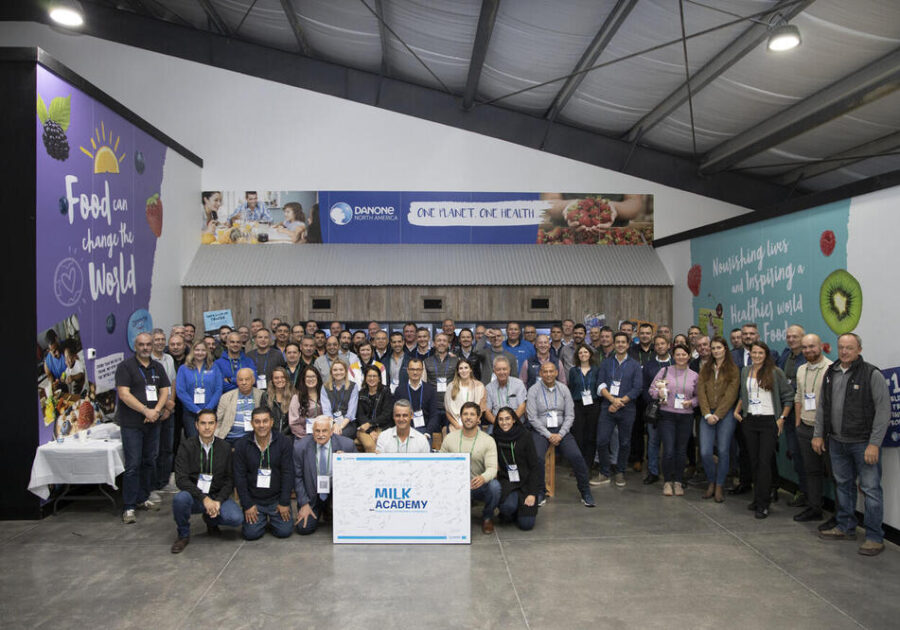
“The first 60 participants at the training in Ohio represent the larger farms in our network,” Verdelet explains. “This cohort has tackled a lot of low hanging fruit and are working to reach the extra mile by optimising technology and innovations to support data-driven decision making and precision agriculture.”
Belgium’s Centre of Excellence, developed in collaboration with Wageningen University, will focus on mid-sized farms across Europe, Latin America, and North Africa. Morocco’s centre, launching in 2026, will adopt a “train the trainer” model to reach Danone’s extensive smallholder community.
“This tiered model ensures an inclusive upskilling model to provide the right knowledge, tools and solutions that best fit our farmer partners’ needs and context,” Verdelet says. “While each centre reflects local realities they are all built around a single purpose: supporting dairy farmers to adapt and thrive.”
Tackling practical challenges
Adopting regenerative agriculture and methane reduction practices is often easier said than done. Farmers face barriers ranging from cost to technical complexity. The Academy addresses these challenges by tailoring training to local realities and connecting farmers with ready-to-implement solutions.
“The Milk Academy supports farmers to adopt regenerative agriculture practices and other practices such as reducing methane, as a holistic approach to on-farm practices is essential for the future success of dairy farming,” Verdelet explains.
Sessions are designed for farmers at different stages of progress, whether new to regenerative practices or already advanced. Technical partners help connect science with market-ready solutions, while peer-to-peer exchanges foster community learning.
“Peer-to-peer exchanges are also a key pillar of the academy – to create a community platform where farmers can share their own experience and learnings with one another,” Verdelet says.
Scaling knowledge through digital platforms
While the Centres of Excellence serve as hubs for knowledge creation, local training and a digital platform ensure that insights reach Danone’s global farmer network.
“Content from the Milk Academy Centres of Excellence, local Danone training events and beyond will be available in multiple languages and hosted on the digital learning platform for reference,” Verdelet explains. “Above all, the initiative also connects our global dairy farmer network with one another, enabling international collaboration and accelerating the adoption of workable and scalable solutions across our supply chain.”
This digital repository ensures that farmers can access information whenever they need it, while fostering a sense of global community.
Tailoring support to diverse geographies
Danone’s dairy operations span vastly different climates and geographies, from Morocco to Brazil to Poland. Verdelet stresses that a one-size-fits-all approach is insufficient.
“Danone’s dairy operations are global, and we recognise that our farmers operate in vastly different conditions and face different challenges. Therefore, a one-size-fits-all approach is not sufficient,” he says.
Examples of tailored support include genomics improvements and biodigester equipment in Morocco, biogas systems in Poland and Romania, and animal welfare and nutrition programmes in Brazil through the Flora initiative.
“The Milk Academy builds on all of these existing efforts with a collaborative approach that is regional by design,” Verdelet adds.
Measuring success
Danone is embedding performance indicators into the Academy’s rollout.
“We’ll measure both adoption and impact,” Verdelet explains. “Key indicators include herd health and longevity, feed efficiency, soil health, manure handling, and reductions in methane intensity.”
These KPIs are integrated into Danone’s country-level assessments, using tools such as the Cool Farm Tool and aligning with the Dairy Methane Action Alliance framework.
“This ensures transparency and consistency across our global operations and ladders directly into our scope 3 target to cut our methane emissions for fresh milk by 30% by 2030,” Verdelet says.
Contribution to Danone’s impact journey
The Milk Academy is not a standalone initiative but a core part of Danone’s broader Impact Journey, which includes carbon neutrality goals.
“The Academy is a core part of our work to mitigate the impact of our dairy operations, and a key part of the Danone Impact Journey,” Verdelet explains. “It works to strengthen farm economics and safeguard the longevity of our dairy supply, while also directly advancing our science-based targets for carbon and methane reduction.”
Regenerative feed systems, healthier herds, and improved manure management all contribute to lower emissions intensity and greater resource efficiency.
Early feedback
The pilot cohort in Ohio has already delivered encouraging results. Farmers valued the high-quality sessions delivered by Cornell University and appreciated the focus on practical farm management strategies.
“The first sessions in Ohio showed strong engagement and encouraging feedback,” Verdelet says. “Farmers strongly valued access to the high-quality sessions delivered by Cornell University. This combined with focus on on-the-ground farm management strategies and solutions supported unlocking challenges and potential to come for our dairy farmer partners.”
The diversity of participants — from nine countries — also fostered a global exchange of experiences.
“The diversity of farmer participants supported hearing stories from those from all of the world who share the same profession, passion and challenges – creating the beginnings of a community who can share learned-experience to support one another,” Verdelet adds.
Looking ahead: the next five years
Danone’s ambition is to rotate cohorts of farmers through its Centres of Excellence, complemented by numerous local events. The company also plans to foster a Milk Academy alumni network to sustain dialogue and problem-solving.
“Our ambition is to rotate cohorts of farmers through our global centres of excellence, with numerous local events to complement the program’s upskilling topics and structure,” Verdelet explains. “We have the aim to continue to foster a farmer ambassador and Milk Academy alumni network, to enable continuous dialogue, and problem solving between farmers who are experiencing the day-to-day challenges on the ground.”
Academic partners such as Cornell and Wageningen University will continue to shape modules, while technical partners provide solutions. The digital platform will expand with advanced modules tailored to different learning styles.
“The goal is to have a global community and practical learnings that measurably improve productivity, profitability, farm resilience and sustainability year on year,” Verdelet concludes.
Secure supply chains
Danone’s Milk Academy represents a bold attempt to reshape the future of dairy farming by investing directly in farmer resilience. By combining academic expertise, technical innovation, and peer-to-peer learning, the Academy aims to secure supply chains, improve livelihoods, and reduce environmental impact.
As Verdelet puts it: “By tailoring support to local contexts, we’re helping farmers to improve their environmental impact, become more efficient in their productions, thereby reducing emissions – all of which contributing to our collective goal of future-proofed, resilient dairy farms that can continue to contribute to high-quality consumer goods.”
With early feedback pointing to strong engagement and practical value, the Milk Academy is poised to become a defining feature of Danone’s dairy strategy — and a model for how global food companies can partner with.