MC Mühlenchemie unveils pilot extrusion press
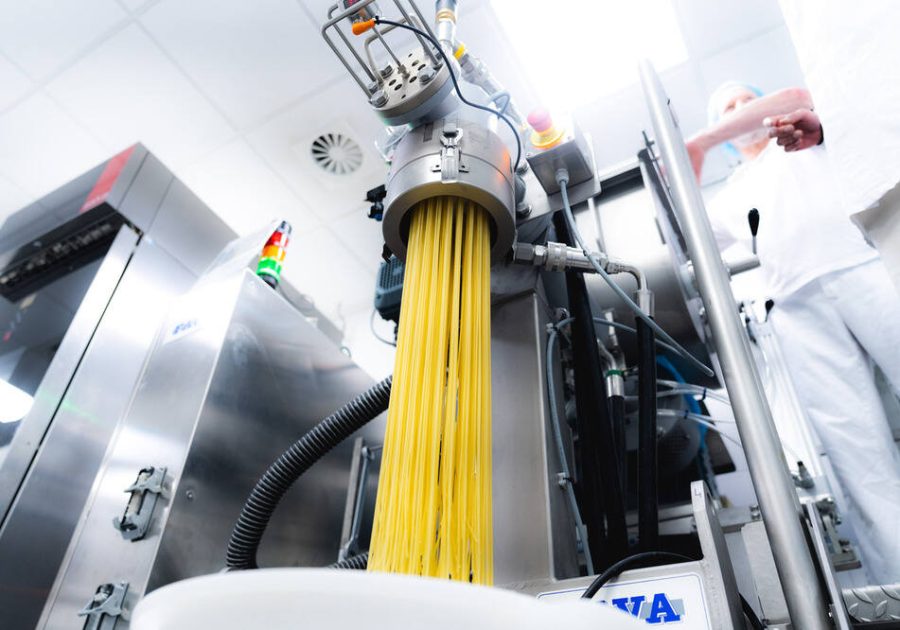
MC Mühlenchemie has taken a step forward in its mission to provide pasta manufacturers with a fully integrated, 360‑degree development service.
The company has installed a new pilot‑scale pasta extrusion press in its Pasta Lab at the Stern‑Technology Center in Ahrensburg — an investment that brings unprecedented authenticity, precision and digital intelligence to laboratory pasta trials.
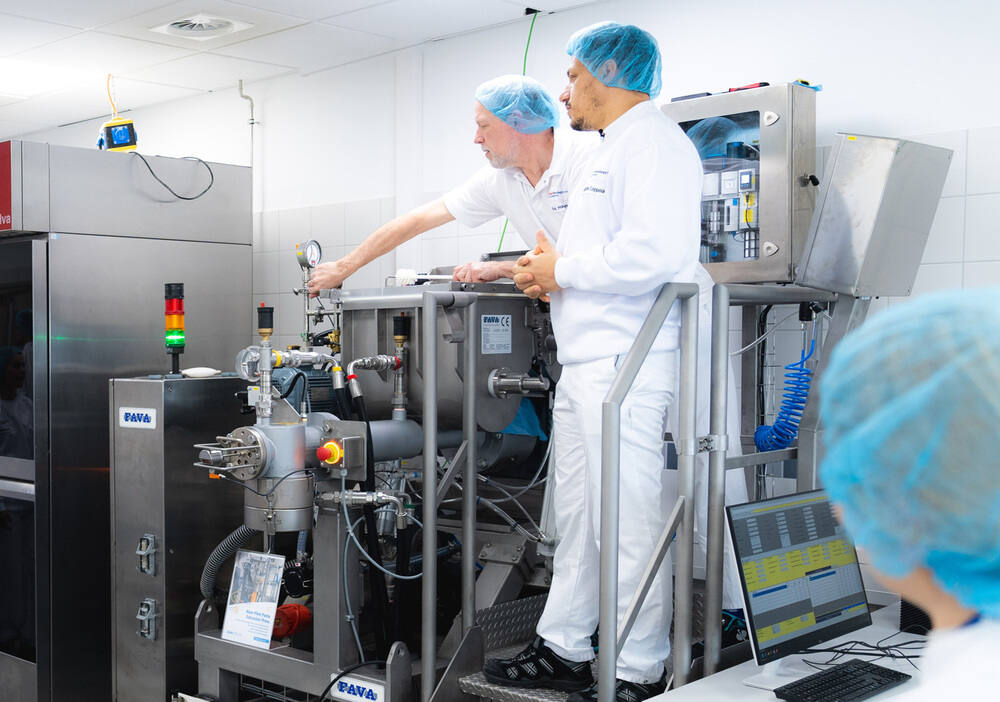
In the new pilot extrusion press, a total of 19 calculation formulas continuously analyse real-time data such as dough temperature and motor load to predict rheological parameters. © MC Mühlenchemie
Developed in partnership with Italian equipment specialist Fava S.p.A., the custom system is the first pilot press in the lab to use vertical extrusion, mirroring the mechanics and dough compression behaviour of industrial pasta lines.
For manufacturers, this means that trials carried out in the Pasta Lab now reflect the real‑world conditions of full‑scale production more closely than ever before.
The new press addresses a long‑standing challenge in pasta R&D: understanding and controlling enzyme activity during the critical phase between kneading and extrusion.
Enzymes play a decisive role in determining bite firmness, stickiness and cooking stability, yet their behaviour is influenced by water availability and dough dwell time — parameters that are difficult to replicate accurately on conventional horizontal laboratory presses.
By covering the full early process — mixing, kneading and extruding — the new system gives technologists far greater control over these variables.
The speeds of the two kneaders can be set independently, while head, cylinder and dough temperatures are precisely regulated. Ventilation speed and temperature during extrusion can be adjusted individually, and the vacuum level in the kneader is continuously monitored. Even dosing water is tracked in real time. Combined with the vertical extrusion path and advanced screw design, the press recreates the compression forces and dough flow patterns of industrial pasta production, enabling results that translate directly to factory conditions.
A defining feature of the new system is its complete digitalisation. Historically, test data had to be recorded manually in spreadsheets, making long‑term comparison difficult. Now, every trial is automatically documented in a digital archive that captures all parameters — from raw material specifications and enzyme systems to extrusion settings and drying profiles. This creates a traceable, searchable database that supports long‑term development work and customer‑specific optimisation.
The press also incorporates artificial intelligence. Nineteen calculation formulas continuously analyse real‑time data such as dough temperature and motor load to predict rheological behaviour. This AI‑assisted cross‑analysis allows MC Mühlenchemie’s development teams to generate data‑driven recommendations more quickly and with greater accuracy.
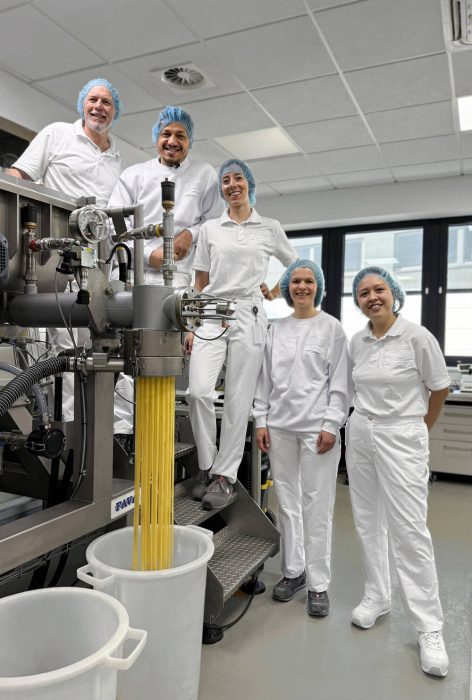
The MC-Pasta team is looking forward to using the new pilot extrusion press to provide its customers with even deeper insights into the behaviour of ingredients and the activity of enzymes in pasta production.
© MC Mühlenchemie
For manufacturers, it means faster formulation adjustments, deeper insight into ingredient interactions and shorter development cycles.
“With the new extrusion press we achieve an authenticity that is unique worldwide in this form,” says Agostino Coppola, senior pasta technologist at MC Mühlenchemie. “Not only can we now precisely replicate industry conditions, with the digitalisation and AI assistance we can also identify interactions that were previously hidden. This is a real competitive advantage for us and our customers.”
The installation builds on the pilot dryer added to the Pasta Lab in 2023, also developed with Fava. Together, the two systems form a miniature pasta factory capable of reproducing the entire production process — from raw flour to finished pasta — under near‑industrial conditions. This enables R&D projects that were previously not technically feasible and provides a systematically comparable database across customers and time.
The collaboration with Fava S.p.A. has been central to the project’s success. The new press was designed specifically for MC Mühlenchemie’s research needs, from mechanical engineering to control software. By combining Fava’s processing expertise with MC Mühlenchemie’s deep knowledge of flour treatment and enzyme technology, the partnership is delivering new tools that help pasta manufacturers innovate with confidence.