Apoha brings real‑time fluid insight to production
Apoha, a London deep‑tech start‑up working at the boundary between physics, data and material behaviour, has emerged from stealth with $36m in funding and a pitch that could have significant implications for food and drink manufacturers.
The company unveiled its plans on the Frontier Technologies Stage at SXSW London, positioning its “Liquid State Intelligence” platform as a new data layer for understanding how matter behaves under real‑world conditions.
At its core, Apoha is trying to solve a problem that has long frustrated scientists and product developers: knowing what a molecule is and what it looks like does not reveal how it behaves once it enters the messy, variable conditions of the physical world.
That gap affects everything from drug development to flavour design. As the company puts it, for decades researchers have relied on “limited and narrow measurements under specific lab conditions,” leaving businesses to make high‑stakes decisions with incomplete information.
For food and drink manufacturers, that blind spot is familiar. Formulations can behave unpredictably once scaled. Proteins denature. Emulsions break. Flavours drift. Texture changes under heat, pressure or time.
Apoha argues that its platform can generate empirical behavioural data that helps teams predict these outcomes before they commit to costly development cycles.
The company calls this new data layer Liquid State Intelligence — a third category of molecular science that sits alongside sequence and structure. CEO and co‑founder Shamit Shrivastava says it has taken “15 years of science and 5 years of company‑building to bring to life,” adding: “Where sequence gave us the language of biology and structure the language of design, Liquid State Intelligence gives us the language of behaviour — what matter, molecules and materials actually do — and we are the company building it.
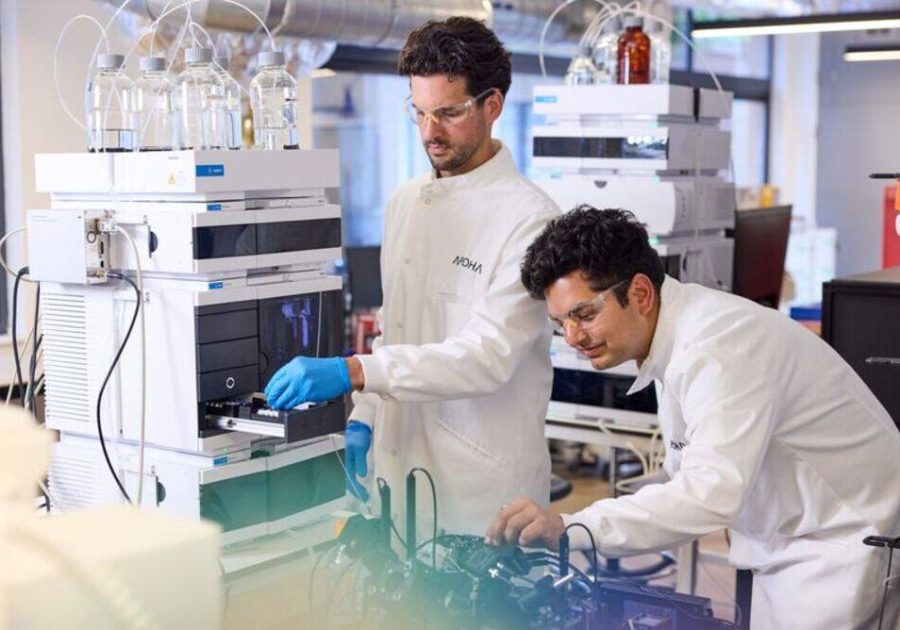
”Apoha’s first commercial product, VIBE, produces a behavioural readout from a sample small enough to sit on the head of a pin.
The platform suspends the sample in liquid, applies controlled stresses and records the wave patterns generated in response. Those patterns become more than 1,000 measured descriptors of behaviour. Instead of testing one property at a time, VIBE captures a multidimensional profile within minutes.
For food developers, that could mean faster screening of ingredients, more accurate prediction of how a formulation will hold up in processing, or early identification of stability risks.
The company points to its work with plant‑based brand THIS, which used the technology “to find a replacement for protein in a product destined for the supermarket shelves in record time.”
Co‑founder and COO Anshika Srivastava frames the opportunity in sensory terms. “Machines have learned to see what matter looks like and to read what we say about it,” she says. “They have not learned to taste, smell or feel matter — to perceive how a drug dissolves, how a flavour holds, how a material wears. That is the layer we are building.”
The funding round was led by Singular, with participation from Draper Associates and continued backing from Redalpine, Seedcamp, Wilbe and Nucleus, alongside Innovate UK grant support. Singular’s Raffi Kamber says Apoha represents “a new generation of European scientific companies where AI is not a future promise, but a practical tool already transforming how biology is done.
”Although much of Apoha’s early commercial traction has come from pharma, the company is already working with multiple food and beverage partners. Its pitch to the sector is clear: if manufacturers can measure how ingredients behave under real‑world conditions before they enter the factory, they can reduce waste, shorten development cycles and improve product consistency.
Apoha’s emergence signals a broader shift as AI moves deeper into the physical world. Vision and language have been digitised at scale. Behaviour — the way matter actually responds to stress, time and environment — has not. Apoha is betting that this missing layer will become essential infrastructure for the next generation of food, materials and biologics innovation.
Topics
emulsions flavours formulation material behaviour texture
PeopleAnshika Srivastava Raffi Kamber Shamit Shrivastava
Organisations