GEA integrates brewhouse processes to unlock efficiency gains
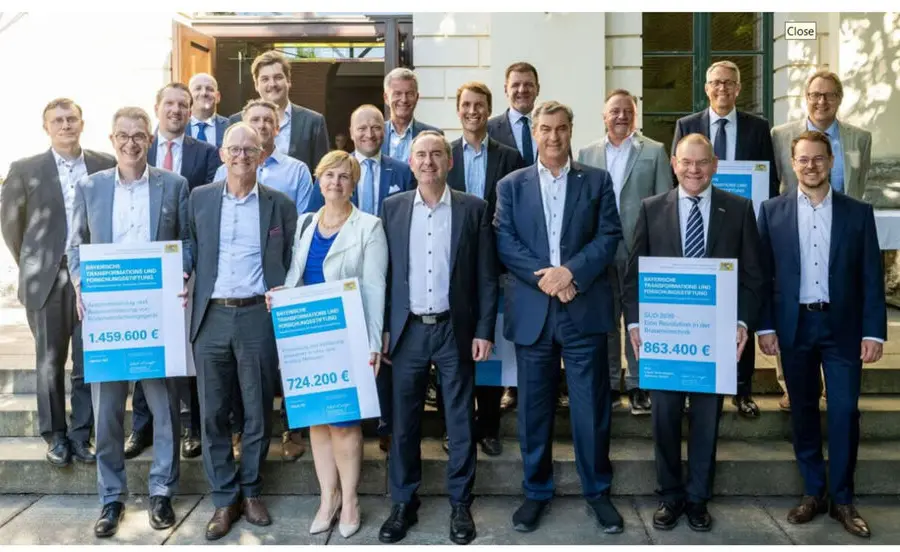
Bavarian Minister-President Dr. Markus Söder and Minister of Economic Affairs Hubert Aiwanger with representatives of the companies that received funding decisions from the Bavarian Transformation Fund at the Prinz-Carl-Palais in Munich on July 16, 2026. Jens Neidhardt and Dr. Daniel Heller accepted the funding decision for the SUD-2030 research project. Photo: Bavarian State Chancellery
GEA’s SUD‑2030 research project marks a shift in how breweries may design future brewhouses: instead of optimising milling, mashing and lautering separately, the company is developing them as one interconnected system.
This integrated approach is intended to support high‑gravity brewing, enabling higher wort concentrations that reduce water and energy use across the brewhouse.
Dr Daniel Heller, project manager R&D at GEA, notes that brewhouse performance depends on how these processes influence one another. Treating them as a unified system opens new possibilities for resource‑efficient brewhouse design.
Why integration matters for efficiency
Higher wort concentrations are a powerful lever for sustainability: the more concentrated the wort, the less water must be heated, cooled or treated. This reduces energy consumption per hectolitre of beer and allows brewhouses to become more compact and cost‑effective. Existing lautering systems, however, hit technical limits when pushed into high‑gravity territory. SUD‑2030 aims to overcome these constraints by improving upstream conditions through coordinated milling and mashing.
Key benefits include:
- Lower water and energy demand — concentrated wort reduces thermal load and treatment requirements.
- More compact plant layouts — integrated processes allow breweries to rethink brewhouse footprint and equipment configuration.
- Improved lautering performance — upstream optimisation supports stable extraction and throughput even at higher gravities.
- Better process stability — treating the brewhouse as a single system reduces variability between steps.
Future brewhouse design
The project spans laboratory work, pilot trials and near‑industrial testing at GEA’s Kitzingen site, supported by research partners including the Technical University of Munich. The Bavarian Transformation Fund is backing the initiative as part of its support for companies navigating structural change.
For breweries, the implications amount to new brewhouse concepts that prioritise efficiency and sustainability; higher extract yields through improved coordination of milling, mashing and lautering; reduced operating costs thanks to lower water and energy consumption; and industrial‑ready validation as findings are gradually transferred into commercial applications.
Jens Neidhardt, managing director of GEA Liquid Technologies, emphasises that the funding enables a structured progression from lab to industrial testing — strengthening innovation capacity and maintaining Germany’s competitive edge in process engineering.