Closing the blind spot

New data from Collo suggests millions of litres of water — and significant production capacity — are being lost annually in beverage plants due to legacy sensing limitations.

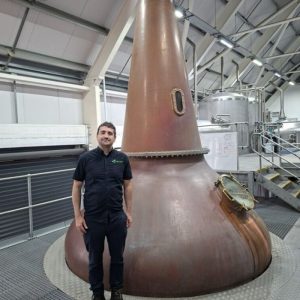
Jani Purorant, CEO, Collo.
CEO Jani Puroranta to Food & Drink Technology explains how real-time RF measurement is reframing water efficiency from an ESG metric into a core driver of operational growth.
Water loss in beverage manufacturing is often viewed through the lens of sustainability targets. However, new findings from Collo point to a deeper operational issue embedded in standard cleaning processes.
According to Jani Puroranta, reclaiming up to four million litres of water annually from a single high-capacity plant is not an outlier, but indicative of a systemic issue. “It’s the norm rather than an exception,” he states.
The root cause lies in uncertainty within the process. “When a plant operator cannot see what is actually happening inside the pipes, they over-rinse… because the consequence of under-cleaning is a product recall or a factory shutdown, while the consequence of over-cleaning is just a higher water bill.”
As a result, fixed-time cleaning cycles — often extended well beyond necessity — have become standard practice. “The inefficiency was always there, it was just invisible.”
Legacy sensing and the ‘blind spot’ in liquid processing
At the core of this inefficiency is the limitation of traditional sensing technologies, particularly conductivity measurement.
Puroranta explains that while conductivity is effective for detecting ionic substances, it fails in complex liquid environments. “It sees electrical charge, not molecular composition.”
In beverage applications, where liquids contain multiple components — fats, sugars, proteins and additives — this creates a critical gap in visibility. “At the critical transition moments… a conductivity sensor cannot tell whether the pipe is clean, whether the product has been fully recovered, or whether the next batch is being contaminated.”
This lack of precision forces operators to rely on conservative assumptions, driving excess water use and product loss.
RF sensing: from proxy measurement to real-time composition
Collo’s approach replaces proxy measurement with direct insight into liquid composition using radio frequency (RF) sensing.
“We can characterise liquids by their dielectric fingerprint, which reflects their actual molecular composition,” says Puroranta.
Unlike optical or conductivity-based systems, RF measurement operates across all liquid types and conditions. “RF is universally applicable… and passes through the full cross-section of the pipe.”
The system delivers real-time data at one-second resolution, enabling operators to identify precise transition points between product, rinse water and cleaning fluids. “We can track in real time… what is inside the pipeline at any given moment.”
Beyond optimisation, this level of visibility also supports quality control. “The technology… is being used to flag product deviations and prevent quality failures before they exit the factory gate.”
From ESG target to production constraint
While water efficiency is often framed as a sustainability objective, Puroranta argues it has become a hard operational constraint.
“If you are already at the ceiling of your water abstraction permit, you cannot simply run another shift or bring in a new line,” he explains.
Excess water use effectively caps production capacity, particularly in water-stressed regions. “The water inefficiency does not just show up as a high utility bill, it becomes a hard ceiling on production volume.”
By reducing water intensity, manufacturers can unlock previously constrained capacity. “Being able to increase unit output with flat or reduced water intake is a genuine competitive advantage.”
Rethinking CIP: from fixed-time to outcome-based cleaning
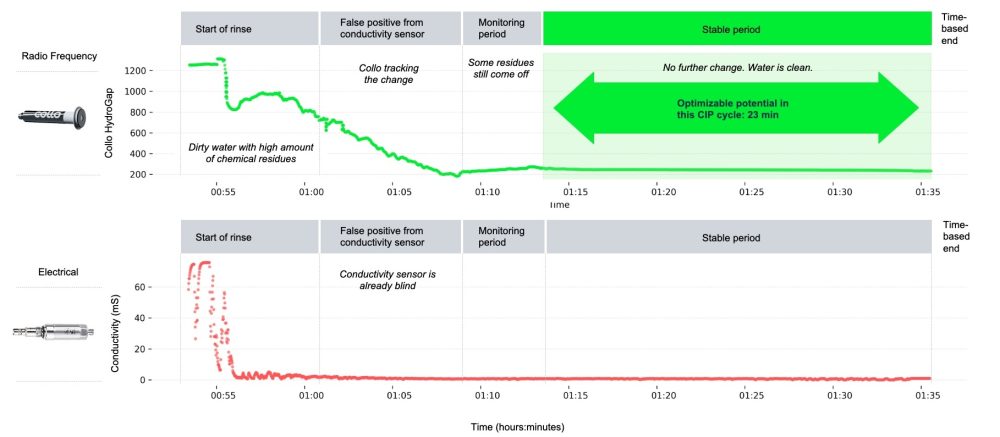
Cleaning-in-place (CIP) processes are among the largest contributors to waterconsumption in beverage and dairy facilities, often accounting for 20–40% of total usage.
The prevalence of fixed-time cycles is driven by compliance requirements, but Puroranta highlights their limitations. “Fixed-time cleaning cycles are a best guess at hygiene, not a guarantee or a measure of it.”
Real-time measurement enables a shift to outcome-based cleaning, where cycles end based on verified cleanliness rather than elapsed time. “When we work with customers to move from time-based to outcome-based cleaning… the water reductions are consistently significant, and product safety is systematically maintained or improved.”
Recovering product, not just saving water
One of the most immediate operational benefits identified by manufacturers is improved product recovery.
“The most common surprise is the volume of product that was being lost during transitions,” says Puroranta.
Without precise measurement, valuable product is often misclassified as rinse water and discarded. “What they do not know is how much… was actually recoverable product that crossed the threshold too early.”
This has direct financial implications, particularly in high-value categories. “Even marginal improvements in recovery translate into meaningful financial returns.”
Decoupling growth from resource consumption
The broader impact of real-time liquid intelligence lies in its ability to fundamentally alter the economics of production.
“You break the correlation between volume growth and resource consumption,” Puroranta explains.
This decoupling allows manufacturers to scale output without proportional increases in water, energy or infrastructure investment. “Capital that would have gone into water infrastructure can go into production capacity.”
As water costs and regulatory pressures increase, these gains are expected to compound over time.
Integration without disruption
A key barrier to adopting new process technologies is integration within existing infrastructure. Collo’s system is designed to address this constraint.
“Our sensors fit into existing pipe sections… without requiring process modifications or production interruptions beyond a planned maintenance window,” says Puroranta.
Deployment timelines are measured in days rather than weeks, with compatibility across standard industrial control systems.
AI as an operational decision layer
The data generated by RF sensing is interpreted and applied through an AI layer, which translates complex signals into actionable insights.
“The first [function] is interpretation… the second is optimisation,” Puroranta explains.
This enables real-time decision-making across production processes, from optimising cleaning cycles to identifying quality deviations. “Over time… the models become more precise and more plant-specific.”
Towards a new standard in liquid processing
Looking ahead, Puroranta sees real-time liquid intelligence becoming a foundational capability across the food and beverage sector.
 “We are at an early stage of the same shift… toward an adaptive, data-driven production,” he says.
As regulatory, economic and sustainability pressures converge, the industry is expected to move away from reactive, lab-based testing toward continuous inline monitoring.
“The plants that build real-time liquid intelligence into their infrastructure now will be in a fundamentally different position operationally and commercially within a decade.”
Beyond beverages: wider industry applications
While beverage manufacturing is a primary focus, the technology is already extending into adjacent sectors.
“We are already active in dairy processing and it is one of our core markets,” notes Puroranta, highlighting the complexity of milk as a processing medium.
Emerging categories such as plant-based beverages and fermentation also present significant opportunities. “Inline measurement… is valuable both for process control and for quality consistency as manufacturers scale.”
A shift from efficiency to capability
Collo’s findings position water efficiency not only as an environmental priority but as a lever for unlocking industrial capacity.
By addressing what Puroranta describes as a long-standing “blind spot” in liquid processing, manufacturers can simultaneously reduce waste, improve yield and expand production potential — without increasing resource consumption.
In this context, advanced sensing moves beyond incremental optimisation to become a core enabler of next-generation beverage manufacturing.