Britain’s cocoa experiment
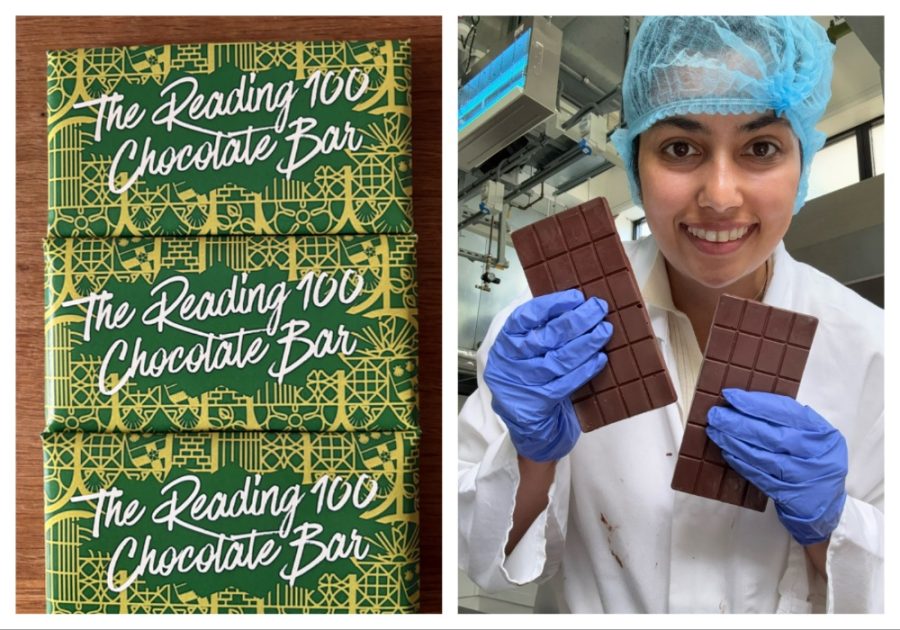
Maha Khan, a food security master’s student at the University of Reading.
Britain’s chocolate industry has achieved an unlikely milestone: a chocolate bar made entirely from British ingredients, including cocoa grown in Berkshire.
The Reading 100 Chocolate Bar was developed by Maha Khan, a food security master’s student at the University of Reading, to mark the university’s centenary. The cocoa was grown, harvested, fermented and processed at the university before being turned into chocolate in its Department of Food and Nutritional Sciences.
The significance lies not simply in the novelty of producing cocoa in Britain, but in what the experiment says about the vulnerability of the conventional chocolate supply chain.
The last known example of a chocolate bar made entirely from British-grown ingredients dates back to 1932, when Rowntree’s produced a bar using cocoa grown in a greenhouse at its York headquarters and presented it to the then six-year-old Princess Elizabeth.
Almost a century later, Reading has repeated the experiment under very different circumstances.
A supply chain under pressure
The UK has a chocolate market worth around £10.4bn, but domestic manufacturers remain dependent on cocoa imported from tropical growing regions. At the same time, cocoa production is facing increasing pressure from climate change, pests and disease.
Khan described the project as demonstrating the “precarious nature of our food supplies”, highlighting the sensitivity of cocoa plants to changes in temperature and rainfall.
That makes the Berkshire crop less a blueprint for replacing imported cocoa than a demonstration of the importance of maintaining a broad genetic base from which more resilient varieties can be developed.
The University of Reading’s International Cocoa Quarantine Centre holds more than 300 types of cocoa plant and plays a major role in the international movement of cocoa planting material. The facility provides researchers with an environment in which different varieties can be conserved and studied while limiting the movement of pests and diseases between cocoa-growing regions.
For chocolate processors, that work could ultimately prove more consequential than the six bars produced so far.
Genetics becomes a manufacturing issue
Cocoa is increasingly a strategic ingredient rather than simply another commodity input.
Poor harvests, extreme weather and disease can affect availability and push up raw material prices, creating consequences that move through the entire chocolate value chain. Recent volatility in cocoa markets has already demonstrated how exposed manufacturers are to events occurring thousands of miles from their factories.
The Reading project highlights another response: improving the resilience of the biological system supplying the raw material.
Maintaining multiple cocoa varieties creates the possibility of identifying characteristics that could help plants cope with changing environmental conditions. That could include tolerance to heat, altered rainfall patterns or emerging pests and diseases.
For manufacturers, this shifts part of the sustainability conversation upstream. Future resilience may depend not only on how efficiently a factory uses energy, water and packaging, but on whether the agricultural systems supplying its core ingredients can continue producing reliably.
The limits of British chocolate
There is, however, an important distinction between demonstrating that cocoa can be grown in Britain and establishing a commercially viable British cocoa supply.
The Reading cocoa is produced under controlled conditions, while a commercial cocoa industry would face a very different set of economic and agronomic challenges. Cocoa is naturally suited to tropical climates, and the university’s own work demonstrates the level of intervention required to cultivate it outside those conditions.
The Reading 100 therefore should not be interpreted as a route towards replacing West African, Latin American or Asian cocoa with British production.
Its value is as a research and development demonstration.
The project has shown that the complete chain — from pod to bean to chocolate — can be recreated locally. That provides researchers with an unusually tangible way of examining cocoa cultivation, fermentation and processing while also communicating the wider food-security challenge.
From novelty to innovation platform
There is also a useful lesson here for food manufacturers.
As climate change increases uncertainty around agricultural raw materials, innovation is likely to become increasingly focused on the resilience of supply rather than simply the optimisation of processing.
That could mean greater investment in crop breeding, genetic conservation, controlled-environment agriculture, alternative growing systems and technologies that allow manufacturers to understand and manage raw-material variability.
The chocolate industry is particularly exposed because cocoa cannot simply be substituted without changing the sensory characteristics consumers expect. That makes securing the future supply of the ingredient more attractive than attempting to engineer around it entirely.
For now, the Reading 100 remains a limited-edition experiment, with only six bars produced and no immediate plan for commercial-scale manufacture.
But its real significance is not whether Britain can become a cocoa-growing nation.
It is whether the food industry can use experiments such as this to understand what its ingredient supply chains might look like in a warmer, less predictable world.
The answer may not be British cocoa replacing imported cocoa. It could instead be a much broader investment in the science needed to make global cocoa production more resilient — something chocolate manufacturers have an increasingly direct commercial interest in achieving.