Tetra Pak cracks fermentation scaling code
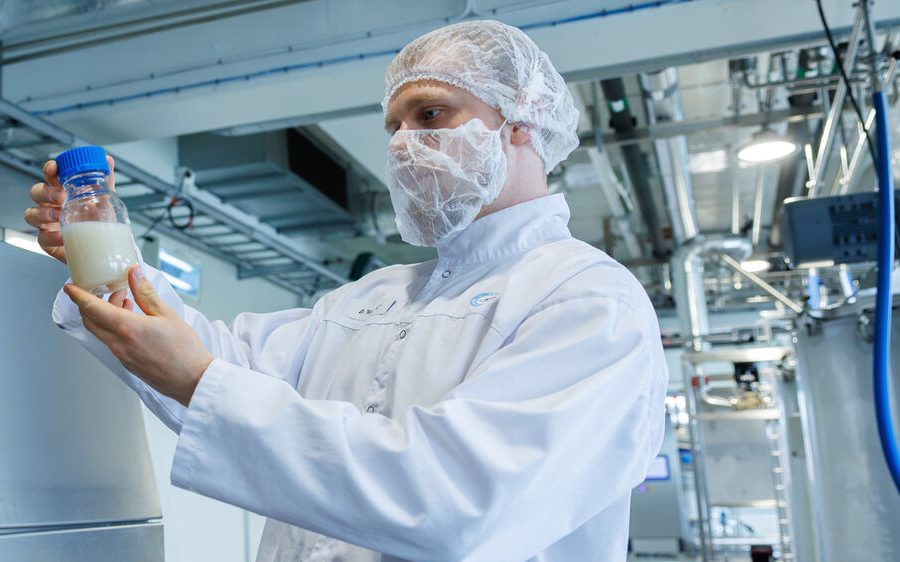
Tetra Pak Bioreactor RF, product sample.
For years, the alternative protein and New Food sectors have suffered from a frustrating paradox. Ingredients like specialised proteins, fats, and flavours work beautifully in small, tightly controlled pilot labs. But the moment producers try to transition those microbes into massive commercial vessels, the biology often rebels.
Scaling up precision fermentation — the process where microorganisms like yeast, fungi, or bacteria brew raw materials into functional food ingredients — means battling intense physical variables. Fluctuating oxygen levels, mechanical failure, and contamination routinely ruin batches.
Tetra Pak’s launch of the Bioreactor RF marks a shift in how the industry handles this scaling bottleneck. Arriving on the heels of its December 2025 acquisition of Bioreactors.net, this is Tetra Pak’s first dedicated industrial bioreactor. It targets the exact mechanical and economic pain points that have historically kept fermentation-derived ingredients from achieving true price parity and volume.
Here is an analysis of why this specific solution directly addresses the industry’s scaling hurdles.
1. Eliminating the contamination culprit: mechanical seals
In conventional industrial bioreactor designs, the shaft that spins the internal mixer (the agitator) passes through the vessel wall via a mechanical seal. Over long production runs, these seals degrade. They become prime breeding grounds for unwanted bacteria, leading to catastrophic batch contamination.
In precision fermentation, a ruined batch is incredibly expensive — losing a run typically costs around €1,000 per cubic meter.
The Bioreactor RF sidesteps this entirely by using a patented magnetic agitation system. By removing mechanical seals completely, it seals off the environment from outside contaminants. While traditional magnetic mixers usually lose magnetic coupling and power as vessels get larger, Tetra Pak’s design maintains consistent torque and oxygen transfer all the way up to commercial volumes.
2. A single software and mechanical architecture
One of the steepest hidden costs of scaling a food tech start-up is rewriting the rulebook at every stage. A pilot plant might run on one vendor’s software and tank geometry, while the co-manufacturer’s industrial facility runs on something completely different. The entire process has to be recalibrated.
The Bioreactor RF line-up spans from 10 litres up to 50,000 litres, yet every single unit utilises the exact same: design platform, control logic, and operating philosophy.
Because the automation and operating parameters are perfectly consistent, a recipe validated at the 10-litre bench scale can be transitioned to a 50,000-liter commercial run with minimal software or process adjustment. This predictability drastically reduces operator training times and shortens the runway to commercial launch.
3. Trimming the financial fat
Building a fermentation facility requires deep pockets, and high operational costs have killed many promising food tech companies. Tetra Pak is leveraging its massive engineering scale to chip away at these barriers in two distinct areas:
Capital investment: conventional industrial bioreactors require custom, onsite engineering and separate external support structures. The Bioreactor RF features an integrated platform design that is pre-assembled and factory-tested. By removing the need for separate structural engineering, it cuts initial investment costs by up to 8% and speeds up installation.
Daily operations: thanks to high levels of automation — including self-adjusting control loops that automatically correct process drift without human intervention — producers can cut ongoing operational costs by up to 12%.
Transitioning from biotech to food processing
“Industrial fermentation succeeds when performance is repeatable, day after day,” notes Rafael Barros, director of the New Food Business Stream at Tetra Pak.
That quote highlights the ultimate value of this launch. Up until now, precision fermentation has lived primarily in the high-risk world of biotechnology. By wrapping this technology into a modular, highly automated framework — and backing it with a global food-grade service network — Tetra Pak is treating precision fermentation less like an unpredictable science experiment and more like a standardised, dependable food processing line.
For an industry looking to diversify ingredient sourcing and improve climate resilience, lowering the risk of scaling up is exactly what the market needs next.