
GEA consolidates biotechnology center to accelerate scale-up
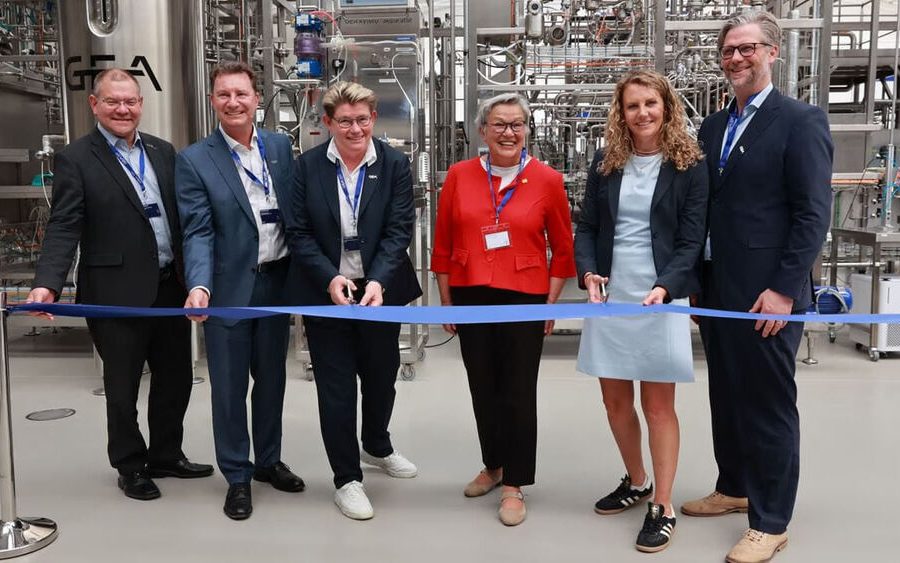
Opening of GEA’s new Technology Center in Sarstedt, Lower Saxony, Germany: Jens Neidhardt, Vice President GEA Liquid Technologies, Klaus Stojentin, CEO of GEA’s Nutrition Plant Engineering Division, Kristina Böe, Senior Vice President Processing Technologies; and Heike Brennecke, Mayor of the City of Sarstedt, Frederieke Reiners, Vice President New Food & Biotech and Reimar Gutte, Senior Vice President EMEA, Nutrition Plant Engineering;. Photo: Sommer & Co.
GEA has announced a €4 million investment to relocate and expand its Application and Technology Center (ATC) for New Food and Biotechnology.
Moving from its interim facility in Hildesheim to a permanent, consolidated hub in Sarstedt, Lower Saxony, the move unites GEA’s specialised pilot infrastructure with its primary engineering divisions under a single roof.
The strategic consolidation addresses a major bottleneck in the alternative protein, ingredient, and biotechnology markets: the transition from laboratory discovery to economically viable, industrial-scale production. By anchoring the ATC at its established Sarstedt engineering site, GEA expands the facility’s workforce to roughly 240 specialists working across engineering, sales, automation, and ongoing support services.
Bridging the gap from lab to factory floor
Scaling up biological processes like cell cultivation and precision fermentation is incredibly difficult. While an alternative protein or functional enzyme may perform perfectly inside a small lab beaker, scaling that same biological process up to thousands of litres frequently introduces issues with consistency, contamination, and fluctuating yield quality.
The consolidated facility allows manufacturers to test and optimise technical assumptions at a pilot scale before committing major capital to industrial factories. To simulate real-world conditions, GEA links bioreactors ranging from 50 to 500 litres with essential upstream and downstream processes. These include media preparation and sterilisation, centrifugal separation and advanced filtration, and hygienic equipment design and automated process controls.
By evaluating these interconnected phases in a unified environment, producers receive robust technical data. This gives brands a solid foundation to secure corporate financing, partner with third-party contract manufacturers, or proceed directly with industrial factory blueprinting.
Tangible commercial protections for producers
Early process validation protects producers from expensive capital misallocations. Frederieke Reiners, vice president of New Food & Biotech at GEA, stressed how early piloting minimises financial exposure for start-ups and corporate food labs alike: “A good lab result creates interest. A solid process creates confidence. And sometimes the most valuable outcome of a test run is a clear no – because a process isn’t stable enough yet, or the cost structure simply doesn’t hold up. Learning that early can save a company a lot of time and capital.”
Expanding beyond alternative proteins
While public attention often centres on meat, dairy, and fish alternatives, GEA’s expanded centre is built to service the broader industrial biotechnology market. The facility’s pilot systems are fully equipped to develop and refine high-value functional ingredients, including amino acids, specialty vitamins, agricultural feed, custom enzymes, and natural flavours.
The investment arrives as the German federal government prioritises precision fermentation as a critical technology for safeguarding future supply chains against volatile climate risks, animal health crises, and raw material scarcity. By establishing this scale-up ecosystem in Sarstedt alongside partners like the Biotechnology Fermentation Factory (BFF) and Solar Foods, GEA ensures that promising cellular research can quickly transition into reliable, repeatable, and commercially viable food technologies.
Topics
alternative proteins biotechnology cell cultivation enzymes flavours Functional ingredients precision fermentation
PeopleOrganisations