Lotus Bakeries doubles down on Biscoff capacity as Europe drives latest growth
Lotus Bakeries has entered the second half of 2026 with strong momentum, reporting a 14% increase in first-half revenue to €749.1 million and signalling a significant acceleration of investment behind its Biscoff growth strategy.
The results are notable because they demonstrate how Lotus is responding operationally to sustained consumer demand: by putting manufacturing capacity, geographic proximity and supply-chain flexibility at the centre of its expansion plans.
Underlying operating profit increased 19.4% to €131 million, while underlying EBITDA rose 20.9% to €156.3 million. Net profit was up 23.5% to €98.1 million. The company said volume growth, strong operational performance, the successful start-up of its new Thailand facility and its partnership with Mondelēz all contributed to profitability increasing faster than sales.
But it is the performance of Biscoff in Europe that provides perhaps the clearest indication of where the business sees its next phase of growth.
Europe remains the Biscoff growth engine
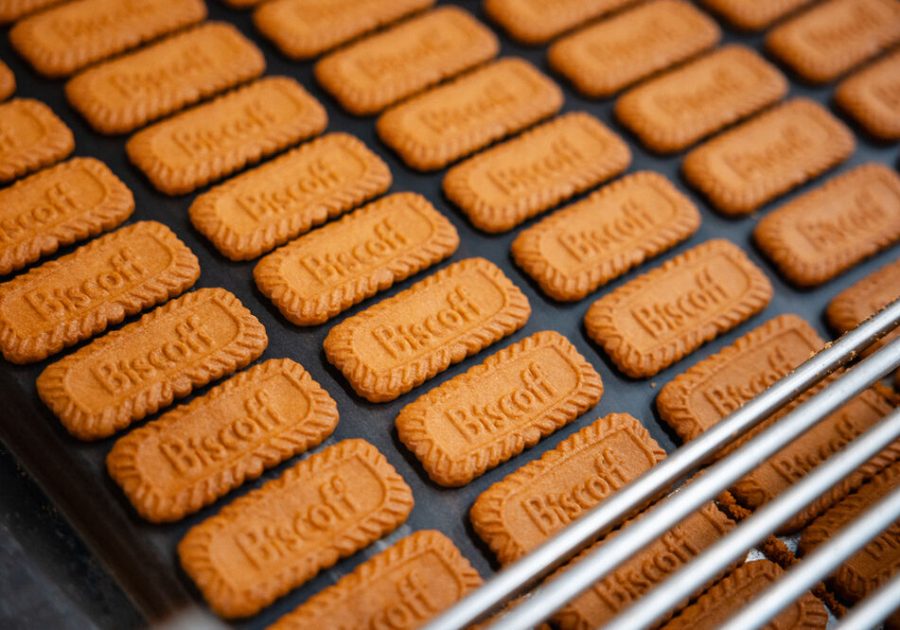
Biscoff revenue and volume both increased by more than 20% in the first half, with growth spread across almost all countries and continents. Importantly, Europe generated the largest absolute increase in revenue.
Lotus highlighted Germany, Italy, Poland, Sweden, Greece, Austria and Portugal as particularly strong markets. That suggests the opportunity is about increasing penetration across a much broader European consumer base.
The implication for Lotus is significant. Biscoff has moved beyond being a successful biscuit brand to becoming the company’s principal global growth platform, but Europe remains a critical production and commercial base from which that growth can be supported.
That is reflected in the expansion of the group’s Lembeke site in Belgium. Ground was broken in May for an additional production hall, consolidating the facility’s position as the largest single-product cookie production site in Europe.
The investment is effectively a statement of confidence in the continuing European demand for Biscoff, while also giving Lotus additional capacity to supply international markets.
From capacity constraint to capacity advantage
Capacity has become one of the defining issues in Lotus Bakeries’ Biscoff story. The company has already invested more than €350 million over the past five years in additional production capacity and its global manufacturing footprint.
The latest programme goes considerably further.
Lotus plans to invest at least €500 million between 2026 and 2030 across three Biscoff production sites: Lembeke in Belgium, Mebane in the US and Chonburi in Thailand. The company describes this as the largest Biscoff investment programme in its history.
For manufacturers, the significance is that Lotus is not simply adding capacity in one location. It is developing deliberately regionalised production covering three markets: Europe and the Middle East, the Americas, and Asia-Pacific.
The objective is to produce the full range of Biscoff hero products across those regions while increasing operational flexibility. Lotus says its existing global footprint already provides a degree of interchangeability between regions, with the new investment expected to strengthen that flexibility further.
Lembeke’s strategic role
For Europe, the Belgian investment is particularly important.
Lembeke’s expansion reinforces the plant’s role within Lotus’ wider manufacturing network and its position in Europe’s biscuit industry.
At the same time, Lotus is expanding capacity elsewhere to avoid relying excessively on European production for global demand.
In Thailand, the first phase of the new Chonburi Biscoff facility is now fully operational and performing at the upper end of expectations. The site is designed to support continued growth in Asia-Pacific, which already accounts for approximately 15% of Biscoff’s total revenue. Groundwork has also begun on a second production hall, with the first new line expected to become operational before the end of 2027.
In the US, meanwhile, Lotus is building an additional production hall at Mebane for Biscoff cookies and spread. The building is expected to be commissioned in mid-2028, with additional capacity coming on stream towards 2029.
The result is a manufacturing network designed to grow with the brand rather than allowing demand to repeatedly run ahead of production capability.
Snacking portfolio
Although Biscoff dominates the group’s growth story, Lotus is also demonstrating that it has another European opportunity in better-for-you snacking.
Its Lotus Natural Foods division, comprising BEAR, TREK, nākd. and Kiddylicious, delivered strong sales growth across all brands.
In the UK, nākd. and TREK were the principal growth contributors, with both brands ranking among the top five in cereal bars and significantly outperforming the low single-digit growth of the category.
More importantly for Lotus’ European strategy, the company said its focus on increasing penetration in core European countries is producing double-digit growth in its top five markets.
That gives Lotus a second growth platform alongside Biscoff and reduces the company’s dependence on a single category, while still allowing it to exploit its expertise in branded snacking.
Local Heroes, by comparison, grew revenue by 3%, with waffles, Dinosaurus and Pepparkakor cookies providing the main contribution.
Extending the Biscoff ecosystem
Lotus is also increasingly using licensing and partnerships to extend Biscoff beyond its traditional biscuit and spread formats.
Its partnership with Mondelēz has expanded from the initial Cadbury, Milka and Côte d’Or launches to include Toblerone, Suchard, Freia and Marabou. Further geographical expansion and chocolate innovations are planned, while the two companies are exploring co-branded Biscoff cookies featuring branded chocolate layers.
Meanwhile, Froneri has launched Biscoff ice cream in 13 European countries. Early UK performance has been particularly encouraging, with Lotus reporting “very strong rotations” during the first months of launch.
Strong cash generation gives Lotus room to invest
The scale of the expansion programme is supported by a relatively strong balance sheet.
Lotus generated a record €300 million of underlying operating cash flow over the past 12 months. Net financial debt stood at €115.4 million including IFRS 16 lease liabilities, equivalent to just 0.3 times underlying EBITDA.
That gives the business considerable financial headroom as it moves into a much more capital-intensive phase.
Group capital expenditure for 2026 and 2027 combined is expected to exceed €250 million.
The ability to fund that investment from a combination of strong cash generation and a low level of leverage is important because Lotus is effectively betting that current Biscoff demand is not a short-term phenomenon.
CEO Jan Boone says the ambition is to make Biscoff the world’s third-largest cookie brand. “To achieve our ambition,” he said, “we must capture the momentum in all major markets globally.”
Wider implications
Lotus Bakeries’ results point to a wider manufacturing lesson: when demand for a global food brand becomes sufficiently strong, capacity itself becomes a growth lever.
The company is responding by locating production closer to its biggest growth markets, creating additional flexibility between sites and investing ahead of anticipated demand rather than waiting for capacity constraints to emerge.
For Europe, that means continued investment in high-volume branded food production remains possible even as manufacturers increasingly pursue global growth. Lembeke’s expansion demonstrates that European factories can remain strategically important within a global network, particularly where they provide scale, expertise and proximity to a major consumer market.
The results also highlight the value of combining manufacturing investment with brand development. Biscoff’s expansion into chocolate, ice cream and other formats is creating additional demand for the core brand, while partnerships allow Lotus to extend its reach without having to vertically integrate every category.
There are risks. Lotus itself points to geopolitical uncertainty, the Middle East crisis and climate-related risks as potential sources of continued cost pressure into 2027. Foreign exchange was already a headwind in the first half, reducing reported sales growth by two percentage points.
Lotus is moving from a European biscuit manufacturer with an increasingly international brand into a globally distributed snacking business — and its latest results suggest that Europe, rather than being left behind by that transformation, will remain one of the foundations on which the next phase of Biscoff growth is built.